




On Mar. 25, One Day (2024), directed by up-and-coming filmmaker Yazmeen Kanji, will screen before Mira Nair’s Mississippi Masala (1991) at an event hosted by the Toronto International Film Festival (TIFF). While One Day is about an Indo-Caribbean Muslim teenager navigating her identity, and Mississippi Masala is a cross-cultural romance set in the US, both films explore themes of diaspora, racial politics, and unexpected connections. The sold-out event is a dual celebration of International Women’s Day and the Islamic holiday Eid al-Fitr. It will conclude with a Q&A featuring director Kanji and actress Rebecca Ablack (Ginny & Georgia), who plays the main character, Adeela.
Based in Toronto, Kanji is an award-winning Muslim Indo-Caribbean filmmaker who graduated from UofT in 2020 with a minor in Cinema Studies. As the founder and creative director of Films with a Cause — a consultancy for culturally specific storytelling — Kanji believes in highlighting underrepresented voices. She extends this work into her own films by writing stories about Indo-Caribbean Muslims that challenge norms and preconceptions about Muslim women. Coming from the world of documentaries as a Hot Docs Accelerator Fellow, Kanji is now making a strong break into the world of narrative filmmaking.
Kanji’s debut narrative short film, One Day, follows the story of Adeela, a hijabi high-school student who struggles to find belonging and authenticity at home and at school, even within the Muslim community. As an Indo-Caribbean Muslim, Adeela’s culture is often misunderstood as in conflict with her religious morals. This becomes evident when an Arab classmate labels her as “too liberal” when Adeela says women should have the freedom to choose how they dress—whether that means wearing a hijab or a t-shirt. This moment highlights the unspoken hierarchies and moral policing that often exist within multi-ethnic Muslim communities. Adeela leaves the interaction feeling disoriented and grappling with the contradictions imposed on her identity.
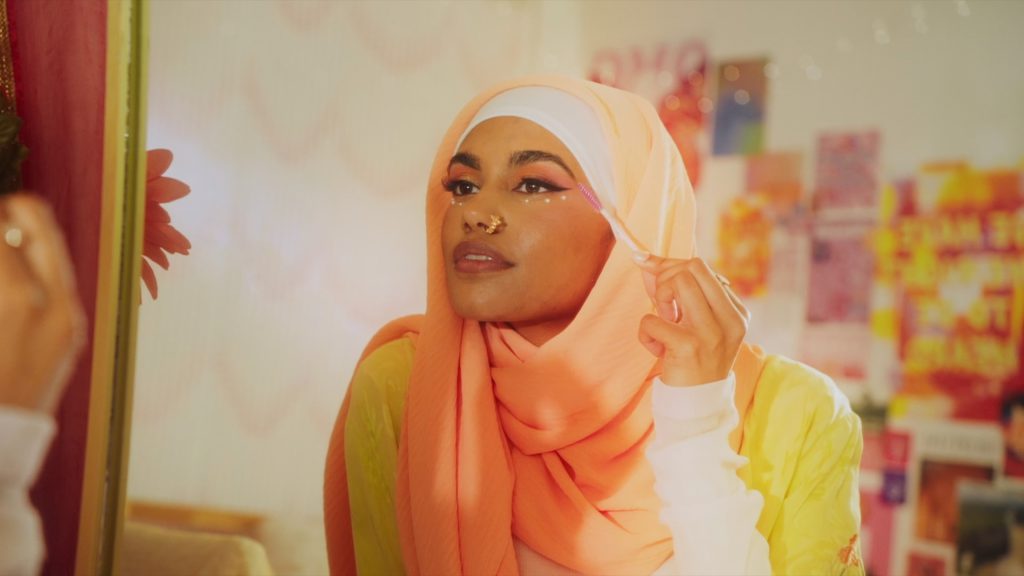
Throughout the film, Adeela is seen daydreaming about having the confidence of another Muslim student, Zarina, who speaks up with ease. “It was really important to me to represent all different kinds of Muslim women in this film,” says Kanji on why she chose to depict Zarina as the self-assured, assertive, and unorthodox woman she is. “I wanted it to be something that kind of confused the audience a little bit — like something where you have your own interpretation of who this person is, and then it kind of gets flipped on its head at the end…And I think that the whole film is also just a way to force people,” both Muslims and non-Muslims, “to confront their own judgments.”
“Art has to be provocative,” Kanji continues. “If I don’t see filmmakers taking risks with their art, I just don’t really respect it, honestly. Because I just think that that’s the whole point.” With her next films, Kanji plans to dive deeper into taboo topics that are not often represented or discussed in media, and she hopes that her first short film here will set the stage for this by establishing who she is and what she cares about.
On the importance of representation, Kanji hopes that “the Indo-Caribbean community is really going to show up for this because they’re so excited.” In regards to Rebecca Ablack, the lead actress who is Indo-Caribbean herself, Kanji discusses how “she has never seen herself represented, and she never got to play a character so close to who she is, so she’s had a really great time just being able to explore her own background through this film.”
Kanji is currently developing her first feature film, an Indo-Caribbean and Indo-East African romance film — what she calls a “child of diaspora love story,” perfect for fans of Mississippi Masala — as well as another short coming-of-age film set at a university frat party. She also recently launched a production company for films and branded content called Cause Studios, which focuses on elevated storytelling for impact.
Learn more about Kanji’s work on her Instagram, at @yazmeenkanji, and her website here.
