

Alex Kvaskov, Assistant News Editor
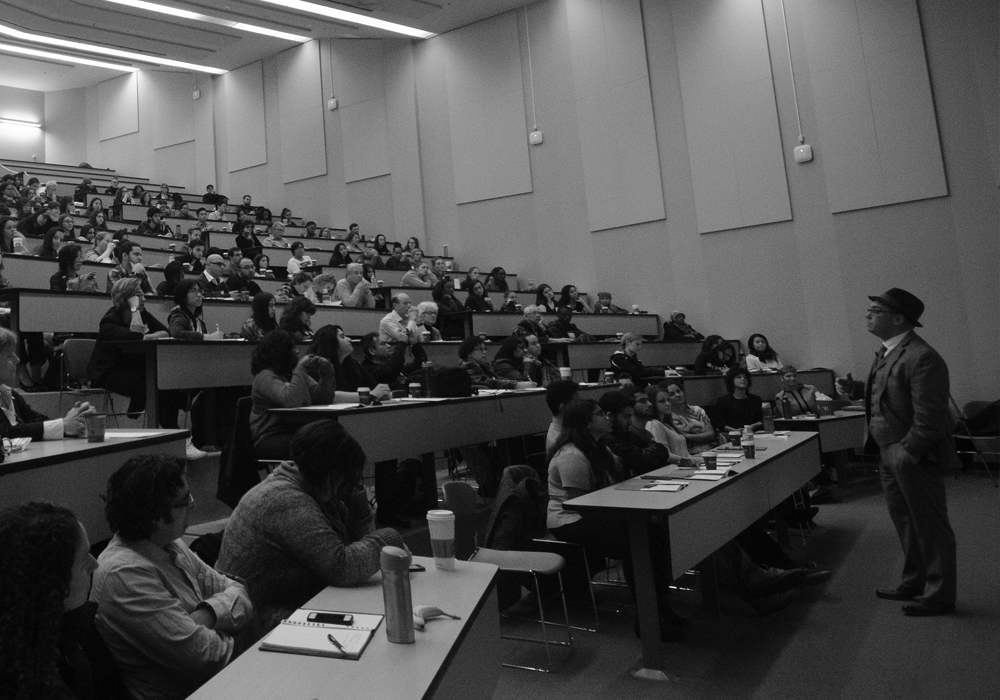
Featured image courtesy of Michael Zusev, Photo Editor
Controversy erupted at York Senate when Senator Ricardo Grinspun challenged President Mamdouh Shoukri, alleging changes to Senate regulations were intended to silence “troublemakers” such as himself.
Previously, senators alleged Senate Executive was becoming less transparent with more in-camera sessions held.
Maureen Armstrong, university secretary and general counsel, says Senate rules do not try to itemize or define “exceptional circumstances.”
“It needs to be left to Senate committees to evaluate in any given situation on whether an in-camera session should be held. The reference to ‘exceptional circumstances’ reflects it is not a regular occurrence and is likely to occur in rare instances,” she adds.
“It needs to be left to Senate to evaluate in any given situation whether an in-camera session should be held,” she adds.
Grinspun also spoke out against the University Academic Plan 2015-2020, one of York’s most important planning documents that sets out priorities for the university over successive five-year periods.
Senate went on to approve changes to Senate procedures and the UAP 2015-2020.
Notably, some senators abstained from voting, raising doubts as to whether all faculty are on board with the direction senior administration wants York take.
Concerns plaguing the UAP include a lack of discussion on issues facing contract faculty and the growing numbers of contract faculty at the expense of tenure stream faculty.
The UAP claims York has made progress toward “faculty complement recovery” and is already hiring full-time faculty, with 12 hires approved for 2016-2017 and 11 retirees. Tenure stream faculty hires will continue beyond 2017 as well, according to Liberal Arts and Professional Studies Dean Ananya Mukherjee Reed.
Improving the student-to-faculty ratios will be “essential,” the plan reads.
The number of tenure stream faculty has recovered roughly to 2009 levels, according to Shoukri.
Some of the UAP priorities include academic excellence, advancing research, enhanced quality in teaching and student learning, a student-centred approach, and enhancing the campus experience.
In order to reach their stated goals, York claims it will achieve financial sustainability, enhance administrative services, and strengthen transparency and accountability.
Despite the grand claims, the UAP does not go into great detail in any one area.
Initiatives are to be implemented collegially, a nod to concerns voiced by faculty that York is moving toward an authoritarian, top-down governance model.
York will champion the liberals arts despite declining enrolment, while expanding in health, engineering, science, business, and professional programs, according to the plan.
The stated commitment to liberal arts comes as a relief to faculty concerned with York’s alleged decreased prioritization of the liberal arts, though it stops short of a fully fledged discussion of the precariousness of academic labour which some faculty have demanded.
In fact, the liberal arts are to dig themselves out by promoting the value of their programs, considering that the value of degrees and university education as a whole is not always well communicated to students, even by York’s own admission.
Moreover, the plan seeks to address York’s top-heavy enrolment structure, with a “large” percentage of undergraduate applications falling into 10 programs by examining the viability of programs and establishing “credible” enrolment targets.
Academic programs might be closed or consolidated if enrolment targets are not met. Faculty members argue enrolment is not a predictor of a program’s viability.
Further, the plan seeks to balance contradictory aims, such as selectivity in admissions and accessibility, while improved student retention is intended to address enrolment problems before enrolment begins to grow again in 2020.
An increased emphasis on metrics and key performance indicators is suggested as a way for York to track performance, including research outcomes. However, the efficacy of metrics in the humanities has been questioned, given the difficulty in quantifying performance in the humanities.
The UAP stresses York’s external context of increasingly stringent demands for metrics, including the province’s performance-based funding formula and a need to demonstrate practical applications for research.
York also promises to implement university-wide mental health and indigenous strategies, initiate a major fundraising campaign later this year, and continue to work on a medical school.
