

Thousands of people across the world gathered to express their sympathy, support, and solidarity with the Kurdish people of Kobani, the city located in Syrian Kurdistan known as the “Rojava,” for their heroic resistance against the brutal forces of ISIS in Syria.
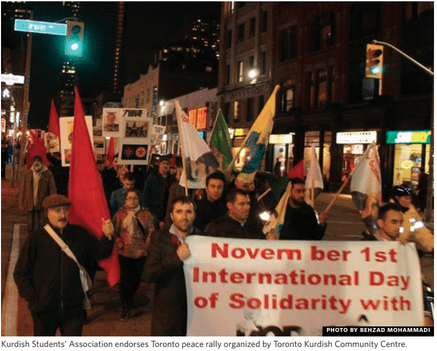
The Toronto Kurdish Community Centre organized a large peace rally in downtown Toronto to commemorate the first anniversary of Kobani’s symbolic resistance against ISIS.
“The world has watched the Kurdish town of Kobani on the Turkish-Syrian border where the Jihadi Wahabi terrorists of the so-called ISIS encircled to conquer from Kurdish people,” reads the TKCC statement.
York’s Kurdish Students Association also endorsed the event and invited all of its members and allies to attend the rally.
[su_pullquote]“It is the duty of all human rights activists to commemorate and celebrate the historic resistance of the brave people of Kobani against the brutal ISIS terrorists who attempted to siege the city and failed,” says Alan Joseph, KSA president.[/su_pullquote]
Nonetheless, not everyone agrees with this assessment of the Kurdish forces in Syria. The YPG/YPJ forces are linked with the Democratic Union Party (PYD), the largest Kurdish party in Syria. Furthermore, the Turkish government of Erdogan continuously accuses the PYD and its forces as inherently linked and a front to the Kurdistan Worker Party (PKK), a Kurdish rebel party involved in armed conflict with the Turkish state to achieve autonomy for Kurds in Turkey.
The alleged links between the YPG and PKK has allowed the Turkish state to initiate a military campaign against the Kurds in Syria, despite the PKK declaring ceasefire.
“Turkey reacted with pointing their guns on Kurds rather than any direction,” said Hadi Elis, TKCC.
In fact, on the same day Turkey announced it would help the international coalition against ISIS, “Turkey’s air force bombed the PKK, not ISIS, and blocked the Kurds from Turkey and Iraq to join the ranks of the resistance forces, the YPG and YPJ,” he adds.
Turkey’s military attacks against the Syrian Kurds were largely criticized in the West too, since the coalition fighting ISIS sees the Kurdish YPG forces as ISIS’s most effective enemy. While both the European Union and the United States affirmed that Turkey had a right to defend its sovereignty, they warned Turkey for its attacks against the Syrian Kurds.
EU’s enlargement commissioner, Johannes Hahn, said the Turkish response “must be proportionate, targeted, and by no means endanger the democratic political dialog,” while the U.S State Department urged the Turkish military to act “proportionately” in its air campaign in the face of perceived threats.
However, Turkey fears that any attempts to establish an autonomous Kurdish region in Syria will inspire Kurds in Turkey to do the same.
Turkish President Recep Tayyip Erdo?an, defied its Western allies and sent out a signal to Kurds in Turkey that “this was a warning. ‘Pull yourself together. If you try to do this elsewhere, Turkey doesn’t need permission from anyone, we will do what is necessary’.”
Despite the long and hard-fought battles, the victory over ISIS in Kobani have united the Kurds and have further inspired them to call for greater political autonomy and independent statehood.
The Toronto Kurdish Community Centre calls on the international community “to help the people of Kobani in its city reconstruction projects and aid the Kurdish people in their struggle for peace and democracy.”
Behzad Mohammadi
Contributor
York students join international day in support of Kobani
About the Author

Interested in becoming a contributor? Check out our Get Involved Page