

When I first came out, I had this idealistic image of the queer community — unity, love, and a drive to make the world a better place where people understood each other’s issues and stood in solidarity with one another.
 I’ve found pockets of this image, but I quickly became disillusioned. What I found, for the most part, was a lot of exclusion and ignorance. How was it that I couldn’t get a single date, while one of my friends (who boasted about having a 9-inch dick) had guys lining up to go out with him?
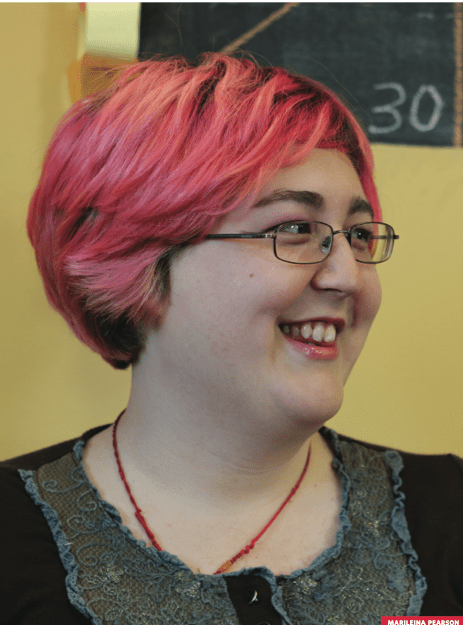
Why did I keep getting passed over for jobs and opportunities by white power gays who got invited to speak in front of classrooms for pay? Why did I still feel so invisible, even with bright pink hair? Am I really so ugly to look at? Am I really intimidating? Why do I feel so much like a monster?
Over the course of my $6,000-a- year therapy — I mean education — I’ve spent a lot of time trying to figure out how oppression works in order to become a better advocate (really, I think it was more about how to deal with my own issues).
To sum up over five years of education, some people are valued more than others, and those who are deemed more valuable are more likely to have better life experiences.So going over my own experiences, I realized that I was understood as a gender-variant body, unlike the gay boys in my school, and was being seen as someone with a disability or as mentally unstable.
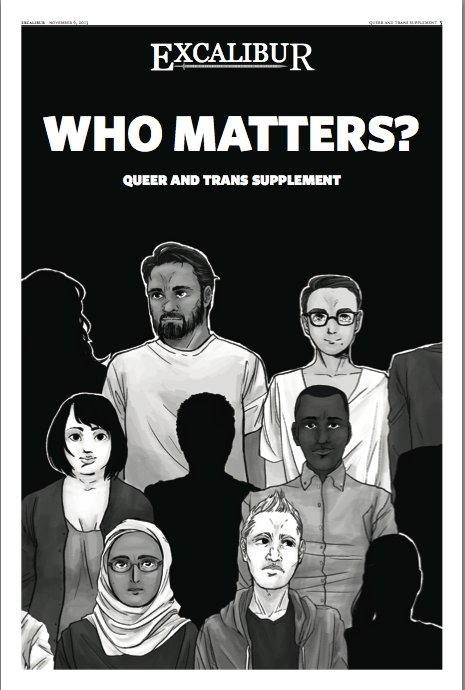
I was marked from the moment I came out as an undesirable body. I was a body that didn’t matter.My experiences are far from unique. In my call-out for this year’s queer and trans supplement, I asked a number of questions.
Who really matters in our communities? Who gets attention or that hot person’s number? Who gets good jobs, tenure, or promotions? Who do we see in the media? Who are our role models?
This is an issue of the outcasts. There are submissions from a number of trans people and other complexly marginalized people who traditionally are not seen as valuable bodies, and whose voices are often not present in main- stream spaces. In this issue is a letter to discriminating washroom users, an ode to the queer wonders of fan fiction, an expose? of asexuality, a call to arms for femmes everywhere, an interview with a gay author and former York professor, an account of real-life violence against queers, and my own piece on undesirability.
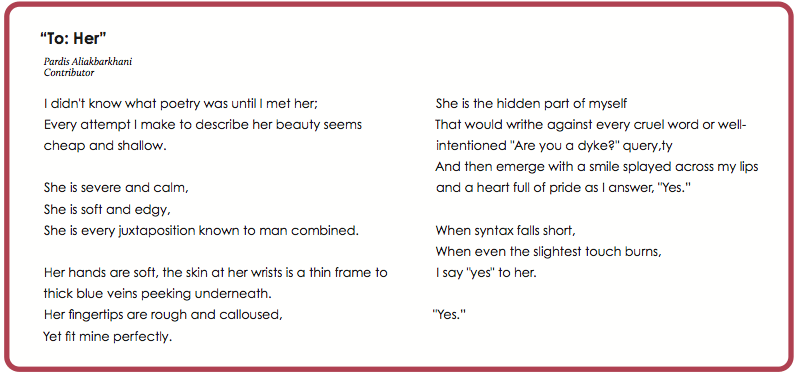
Additionally, scattered throughout you will find the poetry of Pardis Aliakbarkhani.
Featured are her poems “To Her,” “Unoriginal Sin,” “Both and neither,” “You, minus me,” and “Dear homophobe.”
I hope that this issue will, at very least, make people think twice about who is not present. Bridget is a grad student in critical disability studies at York.
Their research at present is on the stigmatization and medicalization of trans bodies, but they really like talking about representational politics, bodies, and porn. They are also on the board of the Centre for Women and Trans People and run the Transfeminine Collective.
Only bites if asked nicely enough.
Bridget Liang
Supplement Coordinator
