

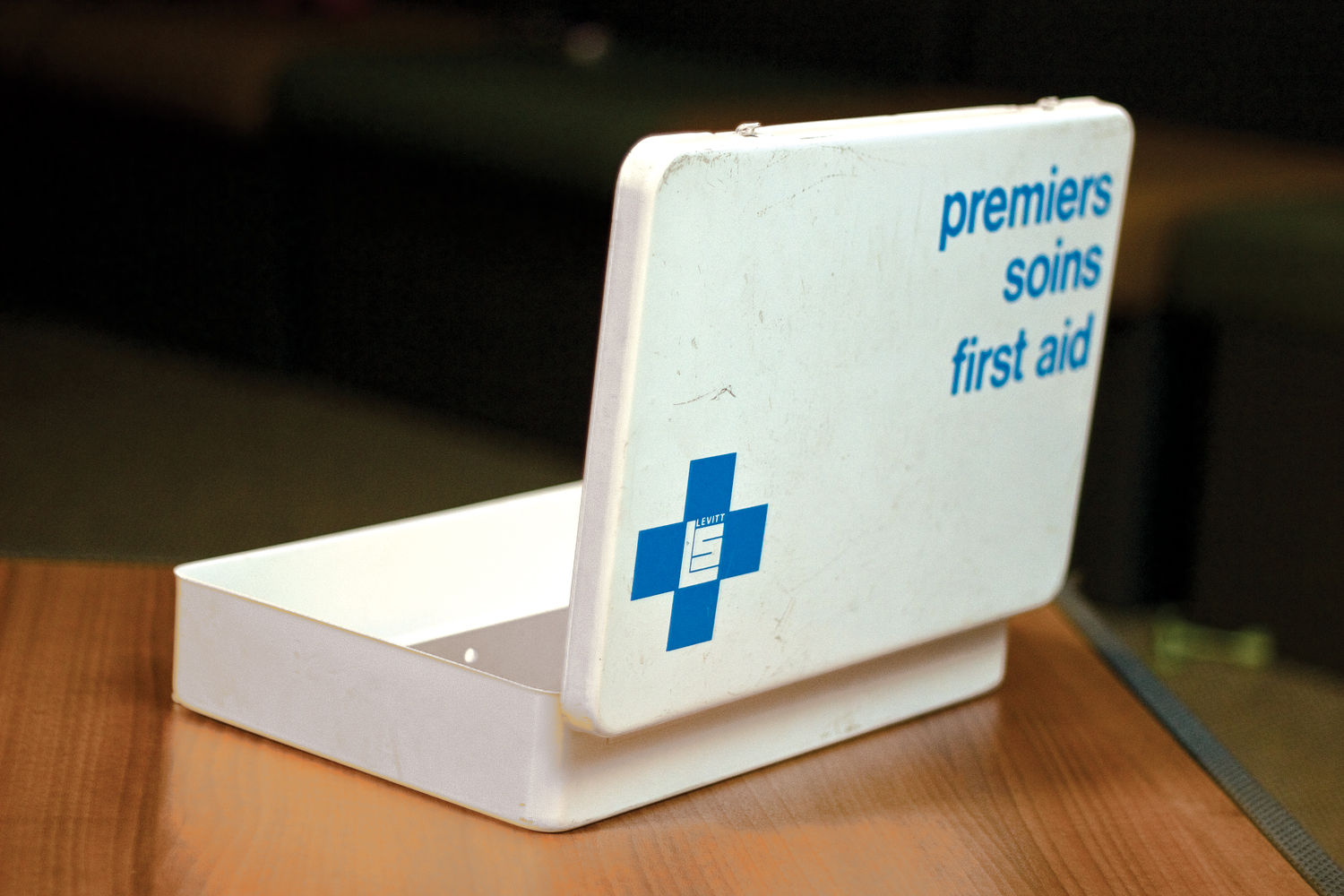
Admin responds to student complaints about lack of basic first aid materials
Hufsa Tahir
Staff Writer

Healing a paper cut is as simple as finding a bandage; but if you’re looking for one on campus, try packing your own.
Following complaints from several students about the unavailability of basic medical supplies to students, Excalibur went undercover to see which university stations and offices carried first-aid kits, and discovered employees at neither Scott Library or the lost and found kiosk had any idea of where to get first-aid, nor did they offer any further suggestions.
The lost and found kiosk redirected Excalibur to Scott Library, where the student employee at welcome services offered to call a supervisor to find out what to do.
There appears to be a lack of awareness of where students can get first-aid; but how much of that is their fault?
First-aid is, in fact, available in Scott Library, confirms Debbie Kolozvari from the Department of Health and Safety at York. She says there are stations around York that can be recognized by the red first-aid cross symbol on posters indicating the location.
Excalibur went out looking for these posters. Finding none, we contacted Kolozvari again.
In areas of high student traffic, she conceded, people wouldn’t necessarily know where a first-aid station might be. She noted that with the sheer number of students, this concern was valid.
When questioned about the library’s policy on limiting its first-aid services to employees, Kolozvari said she had already contacted Health Education and Promotion at York to look at health and safety policies from the perspective of students because, due to the nature of the Occupational Health and Safety Legislation, the focus is generally always on York employees.
“I think that’s something we could also address, small stuff like having band-aids available for students,” she says. “I’m looking to improve this as well as training front-line workers,” she adds.
The injured third-year student eventually crossed campus to William Small Centre, where he finally received a bandage from York Security Services.
Rob Kilfoyle, director of security services, does not feel this is a problem.
“Security is the first-aid responder on campus,” he affirms.
“If you come to the security control centre in William Small Centre, we’d take care of [the wound] and ask permission to do treatment if needed.”
Kolozvari verifies this: “Security officers are trained in first-aid, we do have that first line of defense [in situations where you’d call 911].”
If a situation doesn’t classify as an emergency, says Kilfoyle, he recommends students dial the non-emergency security number. If a situation is more severe, he says, students should then call the emergency number.
“I wouldn’t use those if I had a cut on my hand, but that’s one way of getting a hold of security,” Kilfoyle comments.
Both are posted around campus along with emergency buttons highlighted in yellow boxes; yet, Kolozvari explains the flaws in the system.
“I think the piece that’s missing is that when someone goes to the Lost and Found or to the library kiosk, [the front-line workers] should provide information if student needs access to a first-aid station which would have a kit,” she says. She adds that she is hoping to make changes to training front-line workers so they know where the appropriate services would be.
To cope with the large population on campus, there is constant communication between area Health and Safety Officers (HSO) and front-line workers about the locations of first-aid stations.
“Because it’s such a big university, we have HSOs to help out with the workload,” she says. “But there is no system, no formal website that tells you where the stations are going to be located, for example […] which wouldn’t be a bad idea.”
She adds she will be mentioning the lack of awareness to York’s medical consultant for considering in the future placement of first-aid stations. Kolozvari says trying to organize such a system for an institution, however, it would require a large undertaking.
“From the list of stations I’m getting [from HSOs], there is extensive coverage, but is it perfect? Probably not,” she says. “Can it be improved upon? Yeah, probably.”
When asked to comment on first-aid stations, York Security said they were unaware of them.
“At the end of the day, there are ways to get a bandage,” Kilfoyle says. “Security can treat them, they can buy a pack of band-aids from the [York] Bookstore, too.”
