



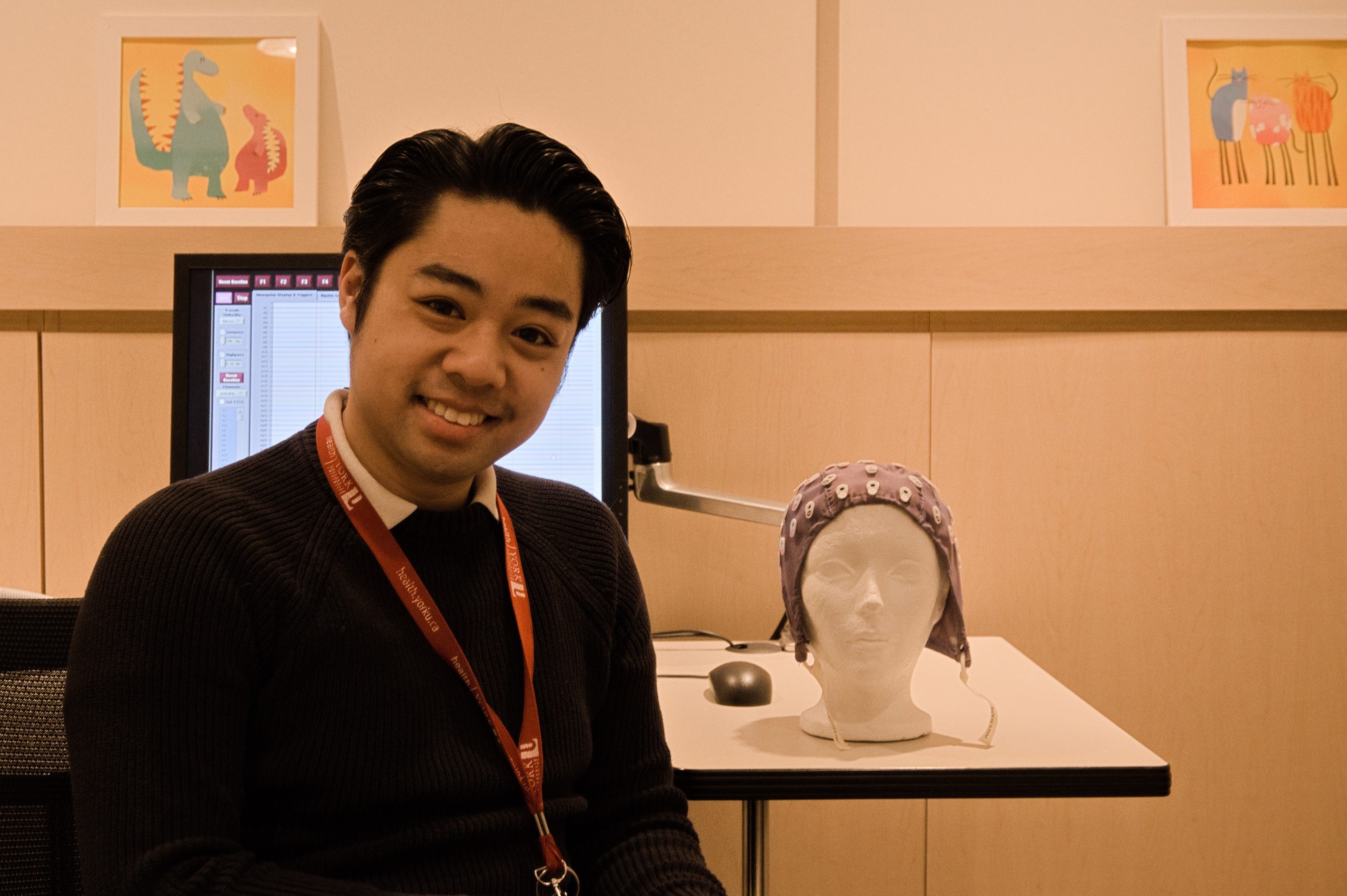
From bee hives to hive minds, germs to worms, from the stars in the skies to the stars in your eyes, York University is home to a vibrant scene of scientific research. In this new and exciting series, Excalibur will profile some of our brilliant scientists, getting a glimpse into the inspiring journeys undertaken by York’s very own student researchers.
We begin our first issue of this installment with Casey Aurin, a recent graduate of York’s Specialized Honours Program in psychology. He currently works as a lab manager in the Memory Development Learning and Brain Lab (MDLaB), directed by Dr. Thanujeni Pathman, associate professor in the Department of Psychology.
Aurin’s research interests were born in a Modes of Reasoning class, where studies in facts and fallacies transformed into a fascination with knowledge itself. More specifically, he became interested in understanding how it is that we humans derive our knowledge: fact, opinion, or otherwise.
Then, he took the Developmental Psychology course in second year, taught by none other than Dr. Pathman. It was there that he developed an interest in Dr. Pathman’s research on memory and cognitive development, and applied to volunteer in her lab as a research assistant. Uniquely, Aurin continued to volunteer in the MDLaB during his second and third year, then also stayed there for his honours thesis — a full-year research project students in the specialized psychology honours program typically complete in their final year — and is now a full-time lab manager for the same lab, where he coordinates different lab projects and contributes both to research and lab administration. Aurin describes his experience as a lab manager as a unique and exciting position, where unlike an undergraduate researcher working on one primary project, he gets to have “all [his] hands on all the projects,” seeing their development and “how they come together.”
Bolstered by his extensive research experience prior to fourth year, Aurin had a very successful experience with his honours thesis project, where he worked with three different professors to examine autobiographical memories in children with autism spectrum disorder (ASD). In his study, he compared the contents of memory in autistic children in the context of different emotions to measure what and how they remember across different emotions. Aurin discusses an interesting implication of his study, where, for example, an autistic child might be asked to act as an eyewitness testimony in a court of law — how much detail should we expect them to be able to share, and how might that change depending on the emotions involved?
For Aurin, the biggest adjustment when he started research was “research itself.” He recalls how he wasn’t exposed to anything like research in high school, and still remembers having to go to the library and the Learning Commons in university to learn how to do in-text citations and basic references. He also speaks of getting used to the hierarchies and power dynamics of a lab culture.
“Coming from a conservative culture,” he notes, “you would often kind of…be shy to speak to professors [and] you [w]ouldn’t ask for help because it may show you are not sure about yourself. I had to learn that self-advocacy is equally as important.” On that note, Aurin advises students beginning research to know what they want to do, and to be unafraid of advocating for themselves and their interests.
Aurin fondly remembers connecting with Dr. Pathman over this adjustment, where she, too, could relate to coming from a different background and culture. He is grateful to have found the MDLaB — he loves the research, he loves mentoring undergraduate researchers and helping along with their journeys, and he describes his lab culture as “a happy bunch of people…all about learning together.”
He notes that while “research is really hard and it needs to be really accurate, and those two things could create friction between people,” his lab cultivates an atmosphere where people are held accountable, but collectively understand that everyone makes mistakes.
Aurin fondly remembers his first task as a researcher back in undergrad: entering data onto an excel sheet. “People think about shiny cutting-edge research when they think about doing research, but a lot of research is actually quite tedious and meticulous.” That being said, Aurin proudly recalls the first time he saw his name on a publication, and the exciting experiences he’s had presenting in research conferences all over Canada.
Outside the lab, Aurin loves to play tennis, being an ex-junior professional tennis player before university. On arriving here, he had an opportunity to join the tennis varsity team, but ultimately decided to prioritize his commitment to research, turning his love for professional sport into a hobby. To Aurin, playing tennis professionally taught him crucial life skills which he brings into his research, like discipline, being organized, and networking with others.
In the long term, Aurin hopes to become a professor, researcher, and specifically, a neuropsychologist. He notes that these goals were solidified from his “work with SickKids Hospital and [his] clinical work at York.”
When asked about one piece of advice he would give to undergraduates starting out in research, Aurin responds, “the advice I give to students is what Dr. Pathman calls grit. It’s this ability to persevere through getting rejections. It’s grit, perseverance, and determination to not give up. We always tell students don’t give up and keep applying, because one day, someone will get through to you and take you on.”
If you are interested in learning more, the MDLaB is currently conducting a new study on the intersection between developmental and forensic psychology, and is looking for volunteers aged 18 to 25 willing to conduct a short interview online alongside their parents. Should you choose to volunteer, Aurin would be more than happy to speak further about his research and journey. To learn more, email mdlab@yorku.ca.
And if you’re an undergraduate interested in this work, Aurin has expressed that the lab is open to taking on new students. For more information, feel free to contact Aurin at the email above or check out the MDLaB website, md.lab.yorku.ca.
Which York scientist do you want featured next on The Petrie Dish? Email copy@excal.on.ca, or send a message to @talesfromexcalibur on Instagram!
