



It’s early afternoon in Accolade East, and you’ve just finished attending your first Introduction to Psychology lecture. With the semester just beginning, you spend a few slides discussing the history of the field. Inevitably, you are introduced to Sigmund Freud, the father of modern psychoanalysis and much of our systemized understanding of psychotherapy. And depending on whom you ask, Freud is even the father of “the talking cure” itself. This is a wonderful story…
… but one that is far from complete.
While this article will not attempt to address the reasons why our textbooks seem to inconspicuously describe the history of psychology as a seed that was planted with the ancient Greeks but curiously only sprouted in the enlightened soil of 18th-century Europe, it will, hopefully, do a little justice to some of the “lost history” in between, profiling a ninth-century Persian polymath who systematically classified and described psychological disorders and their treatments using methods and understandings our clinicians have only today begun to approach.
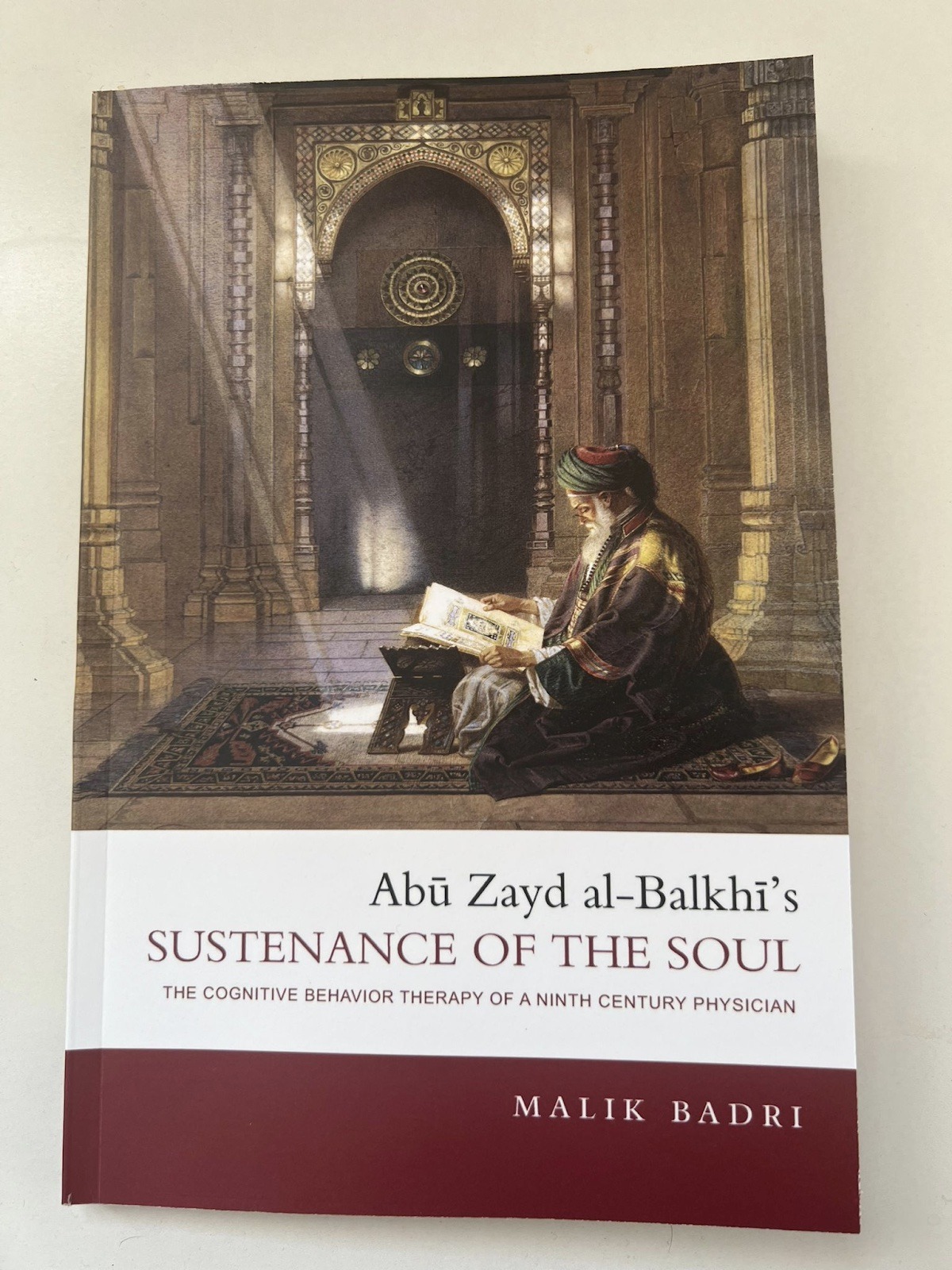
Enter Abū Zayd al-Balkhī (849–934 CE), author of over 60 works on geography, medicine, theology, politics, philosophy, poetry, literature, Arabic grammar, astrology, astronomy, mathematics, biography, ethics, sociology, and (apparently) more. Though more famous for his work on geography, al-Balkhī is considered one of the world’s first known cognitive psychologists, categorizing and describing mood disorders and their treatments in a way that was remarkably ahead of his time. Indeed, in his manuscript titled Maṣāliḥ al-Abdān wa-al-Anfus, or, Sustenance of The Body and The Soul, translated and annotated in 2013 by distinguished psychologist Dr. Malik Badri, al-Balkhī asserts, “As for our section on the sustenance of the soul, we do not know of anybody (before us) that has written on the subject.”
At a time when the neuroses and psychoses we would term today as mood disorders would be brushed aside as cases of demonic possession, al-Balkhī systematically characterized their causes, symptoms, and treatments with unprecedented insight. Now, to call a spade a spade, many of the etiologies (i.e., causes) he describes — both in the first part of his book dealing with bodily medicine, and in the second part on psychological medicine — invoke the classical descriptions of the Galenic humours, an antiquated medical theory which dominated much of Western medical thought until about 200 years ago. But despite these influences, the specificity and acuity with which he describes psychological health and disorder has nevertheless astounded even the psychologists of today.
The section of al-Balkhī’s manuscript that concerns psychology, Sustenance of The Soul, is divided into eight relatively short chapters. The first three introduce the idea of treating the soul just like one would treat the body, providing the motivation and philosophical foundation for his work. al-Balkhī takes his time explaining his rationale, considering the fact that he claims he is the first to write a work on a topic like this, which, due to its novelty, “is not generally mentioned by physicians nor documented in their written books on medicine.” The last five chapters are then spent on characterizing specific psychological disorders and their treatments.
In the first chapter, al-Balkhī speaks to the necessity of treating the entire human being holistically — attending to both body and mind. He begins by establishing that, “since man is composed of a body and soul, he is bound to face from each part of them fitness or weakness, health or sickness.” Interestingly, al-Balkhī mentions how psychological symptoms tend to affect us more frequently than bodily ones, and for this reason, no one should ever be “neglectful in making an effort to shield [the soul] from disturbance and anxiety which leads to an unhappy life. Such psychological symptoms,” he continues, “can thus be comparable to bodily symptoms that cause a person pain and illness and result in an agonizing situation.” al-Balkhī further explains how different people possess different temperaments that lend themselves to various psychological ailments and treatments. Just as people can train themselves to tolerate physical discomforts like minor bodily pains, al-Balkhī advises that people can and should equally train their souls to tolerate frustrating mental experiences and build a stronger psychological endurance over time.
Remarkably, al-Balkhī then mentions that those unable to effectively cope with psychologically stressful experiences — especially in the long term — may even “develop a bodily disorder,” laying the foundation for a pre-modern understanding of psychosomatic medicine more than 11 centuries ago. Psychologists today have only very recently acknowledged that intense emotional reactions like depression and anxiety can result in a myriad of physical disorders, for example through chronic autonomic nervous system activation resulting in weakened immune states. This is one of his many brilliant observations, as noted by Dr. Badri.
al-Balkhī concludes the third chapter by emphasizing that just as bodily disorders and treatments often have internal and external components, so too should mental ones. Externally, for example, a psychologist might offer certain therapies or remedies, which he later elaborates on, but as al-Balkhī notes, “one should not forget or underestimate the value of the internal means in treatment.” He describes beautifully:
As already mentioned, the internal method employed to deal with psychological symptoms concerns a person generating (positive) thoughts within his soul to aid him in suppressing the symptoms and desensitizing their agitation. These tranquil thoughts and beliefs should not only be generated during the illness. They can be nurtured…during times of psychological health…and stored in memory in order to bring them back to consciousness whenever one is afflicted with emotional symptoms.
He then likens this to a mental first-aid kit, where just as one would store medicine for cases of bodily stress, so too should they store positive thoughts and beliefs for cases of mental distress! This distinction between internal and external treatments parallels modern approaches to cognitive behavioural therapy, where clinicians might externally offer therapy sessions and medications, while also promoting internal practices such as cognitive reframing and mindfulness. Moreover, this idea of al-Balkhī’s mental first-aid kit is similar to what cognitive behavioural therapists today might refer to as coping statements, often used in tandem with other practices such as mindfulness meditation.
In chapter four, al-Balkhī discusses his classification of psychological disorders where, according to him, “At the core of all harmful emotional symptoms lies distress, or, anxiety, al-gham.” For instance, before one “experiences rage and anger, a person first feels anxiety and distress concerning the situation that triggers the anger.” The student of psychology will appreciate here how many theories and decades it took for us to develop the cognitive psychology paradigm we have today which explains exactly what he is describing. One is reminded of the famous adage, “I sat with my anger long enough until she told me her real name was grief.”
After anger, al-Balkhī describes three other psychological symptoms (or what we would call disorders) — terror (anxiety), excessive sadness (depression), and extreme whispers (obsessions). He then devotes a chapter for each symptom, detailing their possible etiologies, signs, and treatments.
In discussing anger, al-Balkhī emphasizes using cognitive maneuvers to quell outbursts before they flare up, likening rage to “a fire which starting off small can easily be put out with a little effort, but which if allowed to continue unrestrained, will burst into flames destroying whatever is flammable around it.” Here, Dr. Badri notes that this keen view of anger interestingly seems to be aligned with the most up-to-date research in psychology. Whereas just a mere few decades ago, psychologists still accepted the theory of catharsis in relieving anger, believing that “expressing anger would blow off steam and lessen its effect,” contemporary research has affirmed that outbursts of anger tend to only further exacerbate the flames of anger, not douse them. al-Balkhī then offers various treatments for those struggling with rage, from surrounding oneself with level-headed advisors/friends (external), to redirecting one’s thoughts much akin to the modern therapeutic technique known as cognitive reframing (internal).
The other chapters are equally rife with gems and surprisingly astute observations. In detailing the treatments for anxiety, al-Balkhī mirrors with an almost scary exactitude principles of cognitive and behavioural psychology therapists use today, outlining common treatment methods — like gradual reciprocal inhibition and exposure therapy — with great detail and insight. For example, he explains that the best method for “tranquilizing fear and panic” is a combination of acquiring knowledge “to discover that they are not really harmful” and “repeatedly expos[ing] one’s hearing and sight to noxious things, though disliking the practice, until one’s senses are familiarized by them.”
In his chapter on depression, Dr. Badri notes that al-Balkhī is the first to delineate depression into two distinct categories — a reactive mood disorder (e.g., from the loss of a loved one), versus an endogenous depression with unclear causes and physical/bodily etiologies — and how he differentially discusses their etiologies and treatments is something Dr. Badri describes as “one of al-Balkhī’s most amazing discoveries.” Also, not only does al-Balkhī introduce in this chapter the concept of systematic “gentle encouraging talk that brings back some happiness” (i.e., talk therapy or psychotherapy 11 centuries before it was given a name), but he also prescribes other emotionally positive therapies like music therapy, aromatherapy, and physical medication if needed.
al-Balkhī’s chapter on obsessions is perhaps most striking, where he makes a clear distinction between normal and pathological self-talk. al-Balkhī not only precisely details obsessive-compulsive disorder (OCD) as we would presently describe it, but also proposes treatments we still use today. One interesting analogy he puts forward — one Dr. Badri describes as an excellent example of rational cognitive therapy — is that of “a defendant in court arguing against his own self,” where someone suffering from OCD can falsify irrational thoughts to help neutralize or extinguish certain obsessions. Among other treatments, al-Balkhī also proposes that the human suffering from these obsessive thoughts should avoid being alone, observing that these thoughts are often quelled in the presence of others. Dr. Badri describes this as a “very useful therapeutic technique” not often found in modern psychotherapy or psychiatry books.
Perhaps most beautiful about all of this is his humane approach, where Dr. Badri notes that al-Balkhī constantly “stresses that emotional disorder is simply a learned habit that need not decide people into normal persons and patients.” When reading through al-Balkhī’s treatments, one truly appreciates the agency and respect he endows to the humans suffering from these conditions. As Dr. Badri remarks, “It is a much needed approach in modern psychotherapy which, because it has adopted a medical model, has largely limited itself to a therapeutic endeavor for the sick and not as a form of psychological healing for those who are simply unhappy.” When one ponders the fact that this was all written and implemented hundreds of years prior to the Hospital of Bethlehem — sometimes still (erroneously) considered the world’s first psychiatric institution — which became infamous for the tortuous mistreatment and abuse of its patients, one really wonders what other historical pearls have drowned in the seas of certain narratives.
Alas, the next time someone tells you Freud first sowed the seeds of psychotherapy, consider that they might be off by about one millennium, one continent, and one generous teaspoon of cocaine. But hey, who’s counting?
