



As Esra Ari, an Assistant Professor at Mount Royal University, explained, “multiculturalism, as an official policy, guarantees that all minorities and immigrants can keep their distinct culture in the process of integration into the host society and have equal access to economic, social, and political institutions.”
To varying extents, multiculturalism is a feature of societies around the world, Canada included. As Ari explains, the increased immigration of people of different cultures in Canada, during the later part of the 20th century, led the federal government to develop an official policy of multiculturalism. This policy was eventually enshrined into legislation through the Canadian Multiculturalism Act of 1988. Multiculturalism is also recognized by section 27 of the Canadian Charter of Rights and Freedoms.
Yet, the formalization of multiculturalism as a policy and legal right does not necessarily ensure that the policy and rights are implemented effectively, or that the objectives are realized in practice as is intended and desired. Based on existing research and her own interviews, Ari found that “holding a visible marker of being racially different has been an obstacle to the integration process of immigrants of colour even for Canadian-born youth.” Based on her study of young second-generation immigrants of colour, Ari concluded that multicultural ideology works in diverse and intersectional ways.
Similar concerns were more recently noted by David S. Koffman, an Associate Professor of History at York. According to Koffman, while multiculturalism may have benefited some, it left others disadvantaged. He suggests that, as a consequence, today multiculturalism is “largely dead in practice, if not in name.” As a way forward, Koffman calls for rethinking perspectives and approaches to multiculturalism which involves, among other things, the role of education. The objective would be to reshape perspectives and relations, both between and within communities. Koffman suggests that, if successful, such external and internal revamping of relations could serve as a model for multicultural communities around the world.
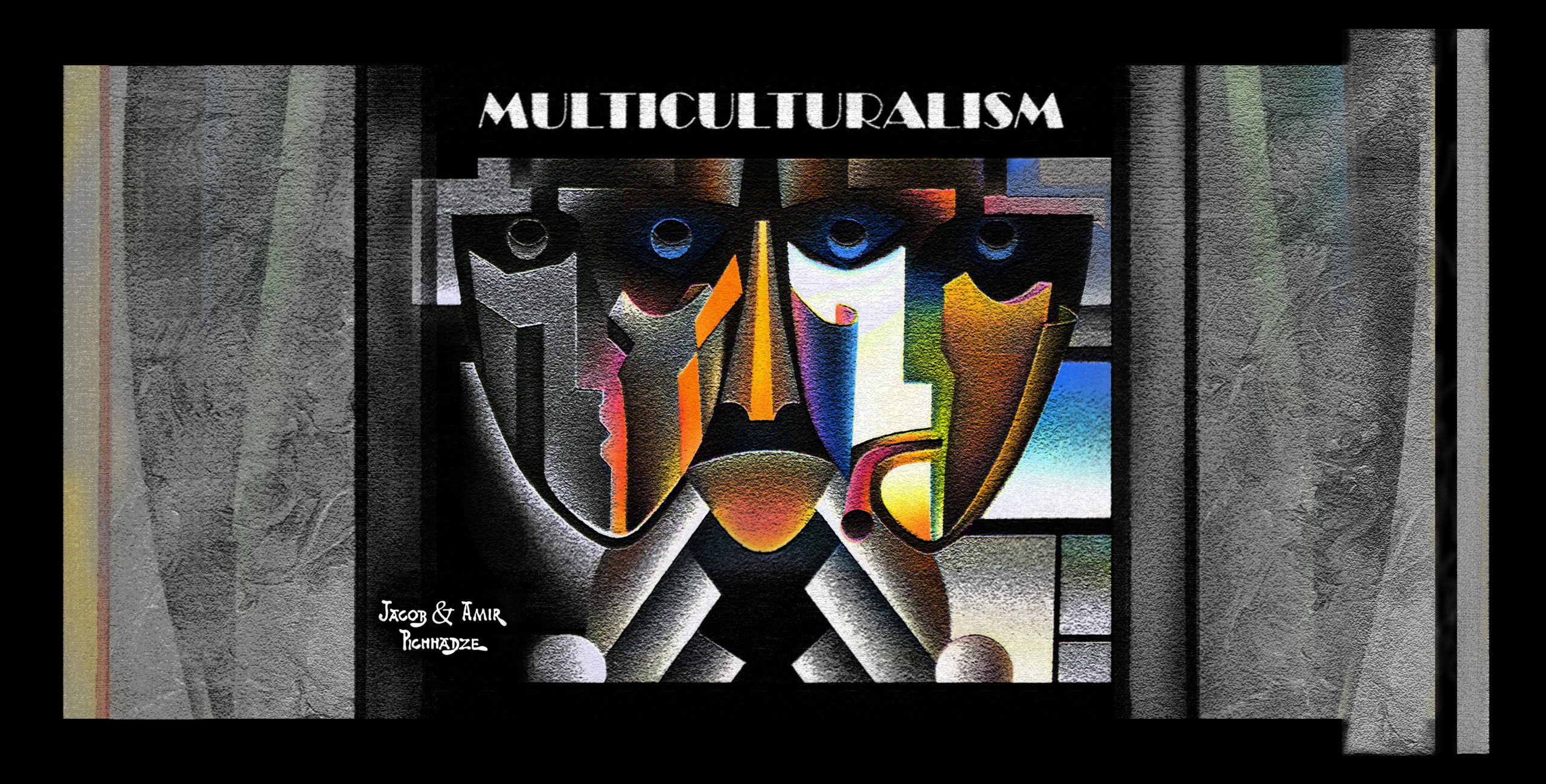
York offers an example of how higher education institutions could have a role in contributing to multiculturalism. The administration has been operating an Equity, Diversity, and Inclusion Strategy that, among other things, seeks to affirm and celebrate diversity. To contribute to York’s commitment and celebration of diversity, my father, Jacob Pichhadze, and I, Dr. Amir Pichhadze, have produced an artwork titled Multiculturalism.
In this artwork, rather than conveying examples of particular and identifiable cultures and persons, we sought to produce a composition that presents unidentifiable abstracted persons who are intertwined. It is therefore a visualisation of “unified diversity” that, it is hoped, can inspire multiculturalism at the university as well as universally.
