
An elderly woman with Parkinson’s takes a cautious step. A calming sonata plays in the air above her. She raises her arms, then twists her body into a twirl. She is slow, but deliberate. She is dancing. For the first time in a long time, she feels like herself again. She feels free.
Later, she lies down and is gently pulled into a white metal tube, the great machine whirring with activity. Detailed images of her brain are scanned and collected.
Meanwhile, somewhere on the third floor of the Behavioural Science Building, a group of young researchers pore over thousands of these brain scans, testing hypotheses and finding ways to improve the lives of people with Parkinson’s while pushing the frontiers of neuroscience research.
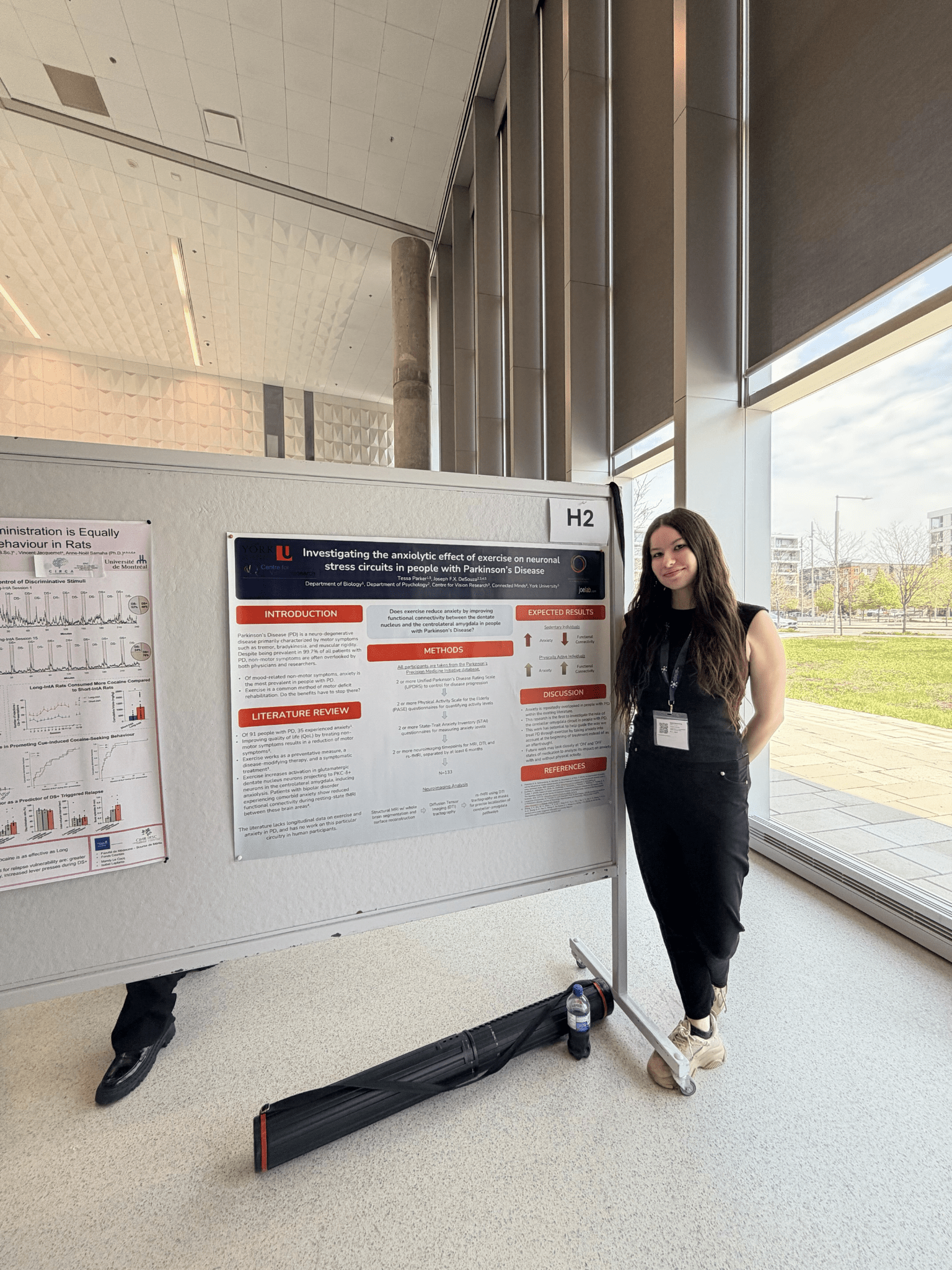
One of these researchers analyzing this brain data is Tessa Parker, a spirited student with a contemplative mind, unceasing curiosity, and a profound drive to better the world around her.
Fourth-year neuroscience major, part-time photographer, and full-time spirit of passion and ambition, Tessa is in the midst of completing her year-long capstone project in the Multisensory Neurotranslation Lab, previously named joeLAB. Supervised by Dr. Joseph “Joe” DeSouza, associate professor in the Department of Psychology, the lab is devoted to studying the effects and potential treatments of different neurological disorders.
Tessa’s research project involves Parkinson’s disease and anxiety, where she studies how doing exercise as a person with Parkinson’s can “induce anxiety relief by acting on the amygdala,” the brain’s primary processing centre for emotions. The bulk of her work is done “by looking at MRIs of the brain and using analysis software to look for statistical correlations” between relevant brain areas. Her research will help neuroscientists build a better map of the connections in the brain, and has implications on different avenues of treatment and pain relief for people with Parkinson’s and other neurological disorders.
Tessa had an interest in pursuing research from the very beginning of her degree, and recalls becoming interested in Dr. DeSouza’s work after he did a guest presentation in one of her introductory neuroscience classes. Despite drafting an email to Dr. DeSouza at that time, it wasn’t until her final year when she joined the joeLAB. Tessa reflects that, in some ways, waiting turned out to be the right decision. “My experiences over [the course of] my degree and the knowledge I’ve collected through my classes have really informed my work, the hypothesis I make, and my approaches to exploring them,” she shares.
Tessa describes her first lab meeting as “intimidating,” and she remembers thinking everyone was so confident and knowledgeable in their work that they must be graduate students. She was surprised to later find that nearly all of her peers were undergrads, and that “everyone at every single level” has doubts surrounding their ability as a researcher. In contrast with the “relatively clear-cut” path of classes, Tessa likens research to “a game of improv,” where “you’re trying to determine what question you’re trying to ask and how you’re going to pursue answering it.” She reflects that the uncertainty often stemming from the open-ended nature of research is ultimately necessary “to be able to see how far you’ve come later down the road.”
Since that first day, Tessa has become one of those confident undergrads, presenting her work at multiple conferences and exploring research directions with the curiosity and insight of a veteran scientist.
One of Tessa’s favourite parts about her work is that at every level, “all research is one big collaborative project.” While providing assistance and receiving mentorship are in-lab examples, she explains, “the collaboration also extends past your lab when you work with other groups, attend conferences, or submit publications for peer review. I’m so grateful to be a little piece of that. It’s a bizarre feeling to introduce new knowledge and data into the world.”
Regarding her specific lab culture, Tessa notes that, “part of what makes our lab unique is the diversity of the projects within it…While I was first introduced to it as a Parkinson’s Disease lab — especially within the context of using dance as a rehabilitation method — there are projects ranging from ADHD, to autism, to martial arts, and beyond.” As a lover of interdisciplinary knowledge, Tessa relishes this multifaceted approach, which exposes her to ideas and perspectives beyond her own research.
Tessa describes her experience working with Dr. DeSouza as supportive and encouraging. She explains, “I feel like I have a lot of room to be ambitious with my work without the fear of being shot down, and that really lets me push myself to do the best work I can.” Further, she reflects on how being encouraged to “attend conferences, present [her] work, and pursue unique opportunities” has built her confidence as a student-researcher. “I’m so grateful to Dr. DeSouza for everything, especially during days where I’m face down on the desk in our lab surrounded by sticky notes and broken code I don’t know how to fix.”
Speaking of hard days, Tessa is no stranger to the often frustrating realities of toiling away on an experiment, which she feels makes success even sweeter. One of Tessa’s proudest moments in the lab was the first time she actually generated results after running an analysis, which she describes as “really insane.” Tessa recalls, “I was with my friend Ashkan, who had been helping me throughout the project, and I remember pacing the room trying to figure out if I had done anything wrong in the process that could have skewed my results [and then] frantically thinking about next steps and where to go from there.” She continues, “it was a while before I really just sat and looked at them and acknowledged the work it took to get there. I think that feeling is part of the draw of research.”
When she’s not obsessing over the brains of others, Tessa nourishes her own by spending time with friends, a value she emphatically prioritizes. “They really keep me grounded and stop me from turning into a research zombie,” she jokes. “Otherwise, I love to write, explore new parts of the city, and bring my camera around with me as much as possible.”
Tessa hopes to pursue a career as a physician or a physician-scientist, and affirms that no matter where she ends up, she “can’t wait to continue engaging in research for the rest of [her] career.” She feels that, “it’s such a privilege to get to be curious about something and then actually pursue the answers. When you’re constantly trying to push the outer edges of your field you’re never going to stop learning about it.”
One piece of advice that Tessa emphasizes for students interested in research is taking time to “identify a project you’re actually interested in.” In a field where a single project can demand hundreds of hours of “sometimes very repetitive and frustrating” work, she believes that it really pays to find a subject you’re invested in. “This doesn’t necessarily mean it needs to be the work you’re planning on committing to for the rest of your life, but it shouldn’t be something you dread,” she explains. In a similarly practical vein, Tessa would tell her younger self to “please listen to your supervisor and use Zotero, instead of downloading it and never opening it for a year because you don’t know how to use it!”
The lover of science that she is, Tessa leaves us with one of her favourite quotes from the legendary physicist Richard Feynman: “We are lucky to live in an age in which we are still making discoveries.”Perhaps some day, an aspiring scientist might say, “We are lucky to live in an age in which Tessa Parker is still making discoveries!”
Only time (and a few more brain scans) will tell.
For more information about Dr. DeSouza’s research, check out his lab website here.
Which York scientist do you want featured next on The Petrie Dish? Email copy@excal.on.ca, or send a message to @talesfromexcalibur on Instagram!
