
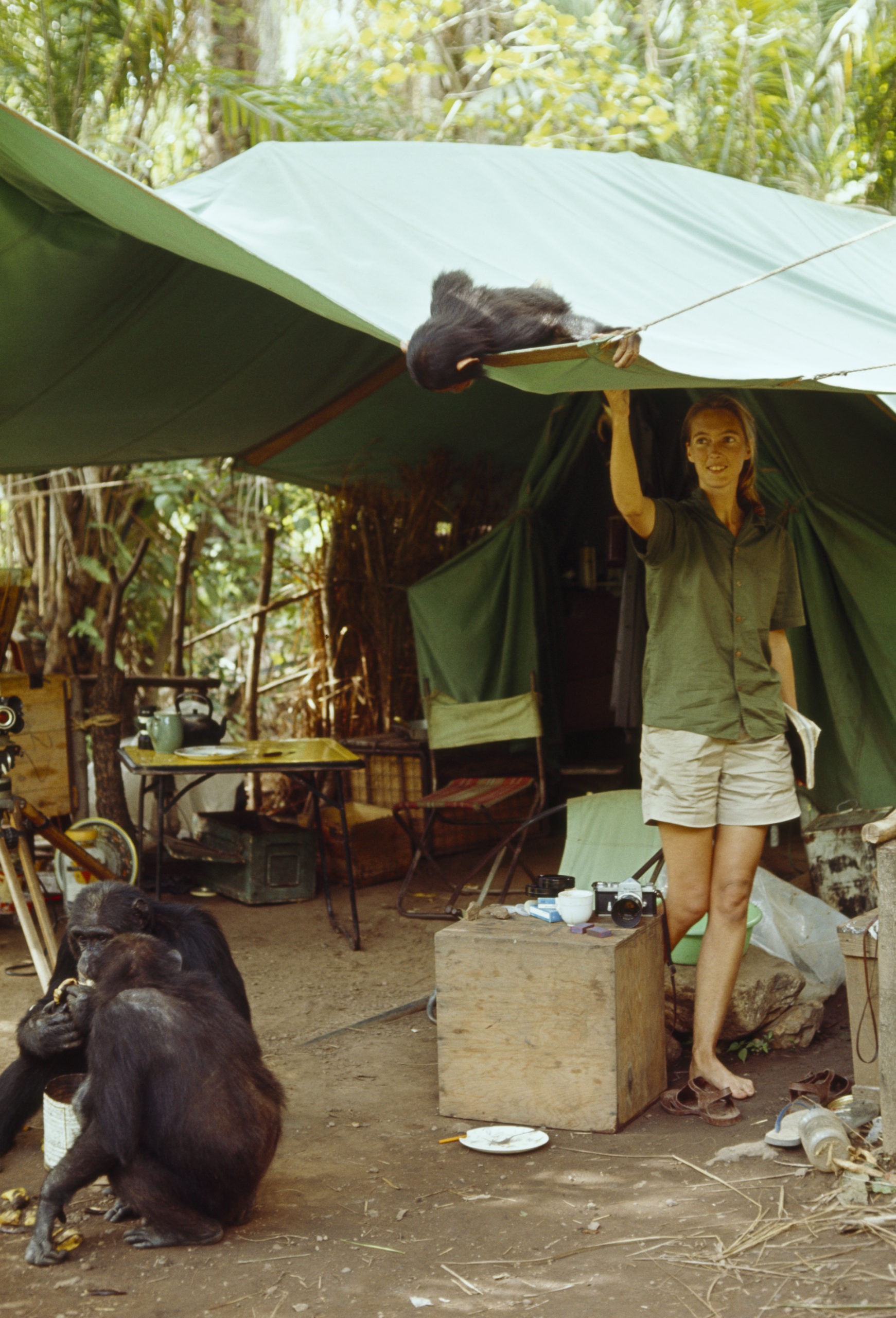
“You cannot get through a single day without having an impact on the world around you.”
From advocating for the environment, to conversing with chimpanzees, the late Dr. Jane Goodall did it all. On Oct. 1, 2025, this incredible woman, who pioneered numerous scientific breakthroughs, passed away. Her legacy is carried on by students studying biology, anthropology, psychology, all the way to political sciences. To those who appreciate what nature brings to our eyes and hearts, Dr. Goodall explored our nature’s deepest curiosities and stoked the fires of our imaginations. Her teachings will forever be etched in books, taught in lectures, and spoken about to other animal enthusiasts. This article will highlight the research and advocacy she devoted her entire life to. She had a legacy that continues to encourage people to engage directly with nature and positively transform the planet.
Dr. Goodall’s most famous discovery was revealing how chimpanzees could successfully use tools and make effective use out of the resources around them. For centuries, it was thought that humans had evolved a unique level of intelligence, demonstrated by our ability to use our surrounding resources as tools.
However, this all changed on July 14, 1960, in Gombe Stream National Park, Tanzania. While surveying the behaviour of the chimpanzees she was studying, Dr. Goodall noticed one bend a twig, remove its leaves, and use it to “fish” termites out of its nest. Dr. Goodall would also observe the chimps using tree branches to split open bug nests and boulders to crush fruits and nuts. They even created a sponge-like structure by chewing up leaves and using the resultant wad to absorb water.
It was David Greybeard (the name Jane gave this chimp) who had changed the perspective of non-human primate behaviour as a whole. Once this breakthrough was discovered, Dr. Goodall eagerly shared her findings with her partner at the time, Dr. Leakey. What he wrote back to her is something that will stick with animal behaviour research forever. He remarked, “Now we must redefine ‘tool,’ redefine ‘man,’ or accept chimpanzees as humans.”
Dr. Goodall’s research sparked a large debate over whether their intelligence could be considered equivalent or extremely similar to our own. It is the now renowned claim that chimpanzees possess genuine intelligence and knowledge, and that their evolutionary lineage may have contributed to the evolution of tool use in humans. This revelation transformed the research area of animal behaviour by introducing the concept that human beings are not that distinct from other species of life.
Dr. Goodall discovered that chimpanzees developed complex social structures and cognitive processes. Between mothers and infants, Jane once noted, “there is a long-term affectionate bond between family members that can last throughout a lifetime.” Specifically, Fifi, a mother chimp under the observation of Dr. Goodall and her team, demonstrated that physical touch between family members is crucial for the first four years of adolescent development. The mother chimp is a multi-faceted figure that serves as a teacher, provider, protector, and playmate informing the social behaviours of her children.
In addition to their social complexities, Dr. Goodall recognized a wide range of emotions within chimpanzees. According to her findings, chimps express a variety of human-like emotions, including mourning. One of the most moving examples of this is Dr. Goodall’s account of Flint, a young chimpanzee who displayed qualities resembling tremendous sadness following the loss of his mother, Flo. Flint’s behaviour, which included refusing to eat, getting weak, and finally dying on the same site where his mother died, indicated that chimps may form profound emotional bonds and experience sadness and loss in ways that are startlingly comparable to humans. This discovery prompted scientists to reassess animals’ emotional capacity and their potential to build meaningful connections.
Dr. Goodall also observed that chimpanzees may engage in “war” with competing groups. From 1974 to 1978, for example, a once-cohesive group of chimpanzees in Kasaleka gradually split into two communities and engaged in conflict. Dr. Goodall discovered that the chimp colonies would vigorously protect their area against opposing troops. In some cases, confrontations turned into savage attacks, with males patrolling their boundaries, ambushing competitors, and brutalizing members of neighboring tribes. Jane discovered that they, like us, are multifaceted and have a dark side that coexists with their compassion and generosity.
Going beyond her revolutionary work in science, Dr. Goodall established multiple organisations to continue her chimpanzee study while also expanding initiatives pertaining to chimpanzee preservation, environmental education, and conservation. In 1977, after Dr. Goodall had made her breakthrough research and her first appearance on National Geographic, she decided to found the Jane Goodall Institute.
Moreover, in 1991, a group of Tanzanian children collaborated with Dr. Goodall to explore how youth might help improve the world. Roots & Shoots was then founded to provide young people the power and tools they need to develop real answers to major concerns. In 1992, The Jane Goodall Institute developed the Tchimpounga Chimpanzee Rehabilitation Centre to care for chimps orphaned from illicit hunting and pet trades. Over 200 chimps are now cared for at the sanctuary.
In 1994, Jane also began community conservation work in western Tanzania. This program, known as Lake Tanganyika Catchment Reforestation and Education (TACARE), was developed as an experimental initiative to safeguard chimpanzees by addressing poverty and supporting sustainable economic development in villages surrounding Lake Tanganyika while also slowing the rapid loss of biodiversity, particularly in the remainder of the indigenous forest.
Then, in 2001, The Jane Goodall Institution conservation science program offered a framework for generating actionable knowledge to aid conservation in making choices, providing advice on chimpanzee populations, and developing agricultural usage that would benefit chimpanzees and the preservation of habitat. When asked about reducing deforestation or for the future of the preservation of land overall, Dr. Goodall stated: “If you want conservation to work, you must involve the people who live there. If they are not part of the solution, there will be no solution.”
Since Dr. Goodall’s work in increasing awareness for animal welfare, animal intelligence, and animal conservation efforts, people and scientists have not only further embraced wildlife, but some have made it their life mission to continue her legacy in preserving the beauty of the planet. Dr. Goodall’s work led many to reconsider traditional definitions of “human” and “animal,” calling into question the boundary between them.Instead of coining our relationship to animals as “them” and “us,” Dr. Goodall joined us together by using “we.” She taught us that animals and humans are not so different from each other, and that we should embrace our differences rather than be scared of them.
In her later days, she became a messenger for hope — hope for the present day she lived in, and hope for the future of our planet. Her message to the world was one that reframes the human experience as a coexistence alongside beings more intelligent and empathetic than we initially thought. We share this beautiful planet with them, and must therefore live on it showing fairness to others different from us, or, in this case, similar to us.
“Only if we understand, can we care. Only if we care, will we help. Only if we help, we shall be saved.”
To Jane, thank you.
