

Helen Lam | Staff Writer
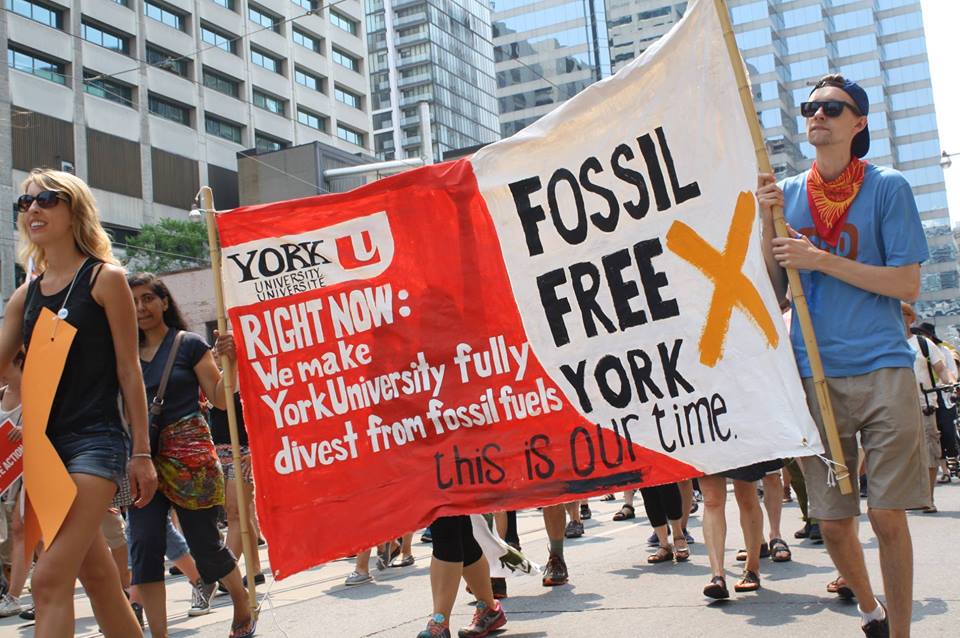
Featured image: A conference hosted by Fossil Free York made the case to divest from companies that use fossil fuels. | Courtesy of Fossil Free York
On January 29, Fossil Free York (FFY) hosted a speaker series sponsored by York’s Graduate Students’ Association, “It’s Past Time: Why York Must Divest.”
FFY, who are a part of the Ontario Public Interest Group at York, is a campaign founded in 2014 that urges York to remove its endowment fund from fossil fuel corporations.
Guest speaker Jody Chan, organizing coordinator for The Leap and an active member involved with U of T’s divestment activism, mentioned Canada has had less victory compared to the U.S. in its divestment initiatives, probably because the boards that Canadian campaigns face are relatively less liberal.
However, many young people have become involved in organizing direct action and making a moral case for divestment. Chan explained that divestment should be a tactic in the broader struggle for climate justice, moving away from pure shareholder activism and including the variety of voices from populations that are harmed by systemic violence.
It also raises the amount of nation-wide attention to the issue, to counter the forces of companies that are funded to give misleading information about climate change.
Chan also noted that Indigenous and Black communities suffer the effects of living in areas full of toxic waste at a disproportionate level. For her, political advocacy for the preservation of natural resources in such regions is a fight for these groups’ human rights.
She told the audience about the concept of corporate accountability—the idea that companies should pay for the harms they cause. As an example, an organization in British Columbia, West Coast Environmental Law, began an initiative called Climate Law in Our Hands, and have sent multiple letters to fossil fuel companies, indicating they must accept responsibility for their actions, which also signaled a potential class-action lawsuit.
For Chan, the power of mobilization should not be underestimated when trying to combat environmental damage done by major corporations, and made this statement to York students: “Institutions in the city are starting to divest, and York should leverage this opportunity to divest as well, and be a leader.”
Sadie-Phoenix Lavoie, who is an Anishinaabe and Two-Spirit from the Sagkeeng First Nation tribe, the divestment organizer and co-founder of Red Rising Magazine, lives in Winnipeg, and takes part in Divest University of Winnipeg (Divest UW). Lavoie discussed how at Divest UW’s general meeting in 2014, several pipelines were presented to the National Energy Board and the federal government. The organization worked with administration at the University of Winnipeg—one that is known for its active promotion of environmental awareness and indigenization—to receive student representation, but the university wanted to explore the risks of divestment.
Lavoie discussed many corporate successes, such as Energy East, as environmental racism toward Indigenous communities. Indigenous activists fought to prevent the expansion of the Alberta Tar Sands. Decolonization is crucial to reconciliation for Lavoie.
Lavoie said that to this day, the sovereignty of Indigenous peoples is continuously undermined, and mentioned they were once arrested while protesting the Kinder Morgan Pipeline in front of Parliament. They emphasized challenging the pipeline is necessary, because sustainability cannot be achieved without divestment from companies that severely harm it. They commented: “There is no such thing as protecting the environment while destroying it.”
Lavoie also brings up the point that lack of funding from the government for educational institutions contributes to the investment problem as well. For Lavoie, going to Standing Rock was another huge step in the direction of justice. They recognize the efforts to divest are tough, but they remind us it is meaningful work. To help with furthering the cause for a greener environment, John Cook, president and CEO of Greenchip Financial, a company that invests in the low-carbon economy, has made the case that instead of divestment, capital investment may be the only path to a more sustainable future.
Greenchip’s stance on investment to protect the environment is based on the economy, not ethics. For example, it is economically favourable to invest in wind and solar energy, as these resources are renewable. Greenchip estimates that an annual solar installation would average 140 gigawatts through 2035, raising the proportion of solar energy use.
Cook presents strategies that he views as effective in guarding the environment, including an investment in technology that increases the product’s efficiency of reducing food waste, levying taxes on carbon emissions, and engaging shareholders of publicly-traded companies to employ run-down business strategies.
Further, he feels shareholders should encourage companies to stop looking for areas to exploit for their resources.
