



Following the Feb. 28 death of Ayatollah Ali Khamenei, Iran is now at war with the United States and Israel, with the death toll climbing both in Iran and abroad as other countries in the region report the targeting of their U.S. military bases.
According to Axios, Iran has reportedly attacked the United Arab Emirates, Qatar, Kuwait, Bahrain, Oman, Saudi Arabia, Jordan, Iraq, and Azerbaijan. Lebanon has also entered the fray, with the militant group Hezbollah joining Iran. Meanwhile, the United Kingdom has reacted following attacks on a British Royal Airforce base in Cyprus, with the U.K. dispatching a Royal Navy destroyer and counter-drone helicopters. France and Germany have yet to strike Iran, though Iran also struck personnel in a German army camp in Jordan.
Since 1989, Khamenei has maintained a theocratic rule and an “anti-western axis of resistance” in Iran. In January 2026, he declared that “rioters should be put in their place,” greenlighting the deployment of security forces against citizen protestors. Iran International, Time Magazine, and The Guardian have all estimated the resulting deaths to be in the tens of thousands.
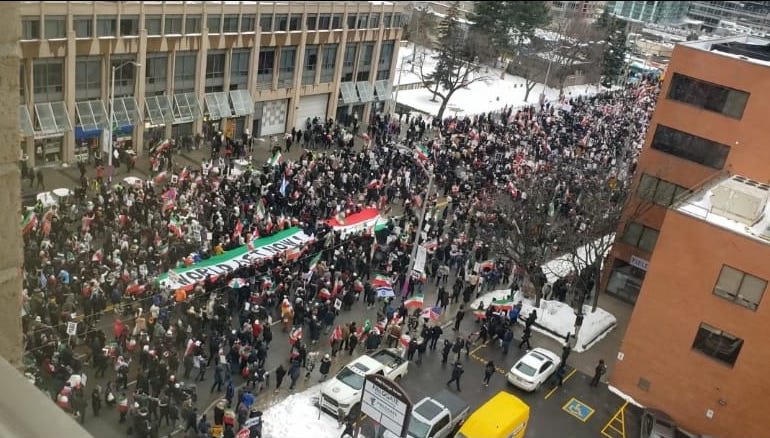
Khamenei’s assassination marks a shocking turn for an already tumultuous Iran. A 40- day mourning period was initiated by the government; thousands gathered in Tehran to grieve, while chants wishing death upon America and Israel mounted. But others celebrated with cheering on balconies, offering one another tea, and riding motorbikes through the streets of Khamenei’s hometown. Iranian diaspora communities abroad, including those in Canada and on campus, also varied in their reactions to the sudden news.
A statement from Iranian Unity at York University (IUYU), issued by Arshia Jamshidi and Aryan Javidi, read that “for millions of Iranians worldwide, the recent escalation involving Iran, the United States, and Israel has triggered complex, deeply personal emotions. For the Iranian diaspora — including students in groups like Iranian Unity at York University (IUYU) — this represents more than geopolitics. For many, it signals a potential end to a regime they believe has oppressed Iran for nearly fifty years.”
Cities across Canada have erupted with rallies in both protest and celebration. However, others are concerned with foreign intervention, worried about the national sovereignty of Iran and the prospect of actual regime change. Most of all, many are concerned for the safety of loved ones still in Iran.
With the flurry of mixed emotions, both Iranians and the international community are waiting to see what happens next. Although the war was projected by U.S. President Donald Trump to last four to five weeks on March 2, Israel bombed Beirut, Lebanon just three days later. It claimed it targeted Hezbollah due to the organization’s support for Iran. With other countries getting dragged in, the exact size and timeline of the conflict remain unclear. Canada has yet to strike any targets, though Prime Minister Mark Carney has pledged support to our allies, who are discussing defending the Gulf states from Iran.
As events continue to unfold, one thing remains for certain: many won’t miss Khamenei, both in and out of Iran.
