



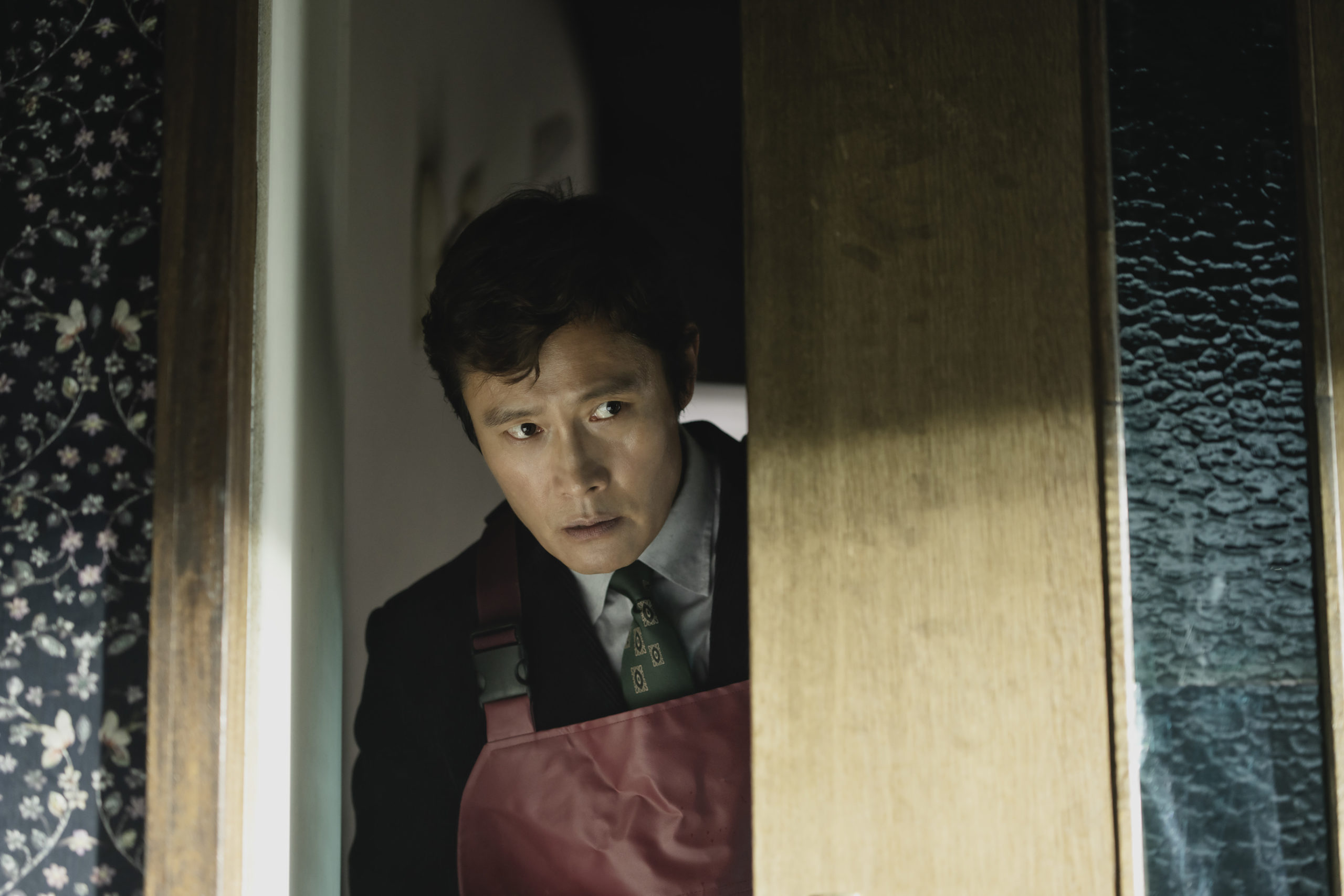
A man loses his job and takes up murder as a hobby. That’s the premise of Park Chan-wook’s No Other Choice, in which Lee Byung-hun plays salaryman Man-su. A paper-industry specialist at a factory upstream from K-Dunder Mifflin, Man-su responds to corporate consolidation by inventing a fictitious job listing and killing off his competition. The film makes unemployment a humiliating experience, relishing in depictions of those subject to polite systems that tell people their lives are worthless in the face of increasing optimization.
It’s the struggle of every Houellebecq novel, though here the story is adapted from a Y2K crime paperback. Lee, carrying worldwide recognition from Squid Game, gives Man-su a calm, clerical composure, redirecting his discipline and his skills as a gardener, bending wire to force a branch into shape, to find application beyond the greenhouse. He faces the math of too many applicants and too few positions in a scarcity economy. The situation may be familiar to those who’ve ever required a final credit to graduate, only to have the qualifying course already full. In a scramble, you email the professor, no luck, then escalate to the department, even facilities, asking for a larger room. When the proposal of this architectural solution fails, you’ve no other option but to remain composed and accept your fate.
The comedy in No Other Choice is in its persistent politeness in the face of murder. Rachel Cusk wrote in The New Yorker last year that films are like spaces where the ordinary limits on socially acceptable behaviour are suspended, where cruelty is always possible, whether it happens or not. Park Chan-wook explores the latency of violence through human error. Man-su’s murders do not go smoothly, interrupted by scheduling conflicts, social obligations, even a snakebite. Chan-wook has perfected the Fincher omniscient camera, which depicts the inevitability of harm by letting the systems that enable it unfold. Architecture is a prime instrument in his work. The Handmaiden is set on a colonial estate that disciplines desire. The mansion is a fusion of Japanese and Victorian styles turned into a fetishized object. Bong Joon-ho’s Parasite is about a house that sorts characters in its floor plan. The mid-century brutalist modern house in No Other Choice is out of a real estate brochure for moral failure, its open sightlines offering a concrete promise of stability, capable of staging almost anything, from bonsai binding to corpse hiding.
The performances are geometric. The “Korean acting style” has a calibrated artificiality. Faces become schematic, gestures choreographed, in a type of rendering not unlike Ari Aster’s arrangement of figurines. Except it’s on the body instead of in the blocking, the anime-adjacent way emotion is rendered and diagrammed, turning the actor into a prop with agency. This style has begun to surface in performances in American films as well, where emotion is more a setting than a revelation. Robert Pattinson in Mickey 17 uncannily adopts a calibrated artificiality, in which emotions seem to be toggled on and off.
The violent character arc in American cinema is understood as spectacle or redemption, something to watch or, sometimes, to believe in. Films interpreted as critiques of capitalism or masculinity are often based on escapism. A character opts out of a system collapsing under excess or acts out revenge in the pursuit of purification. No Other Choice puts brutality at the heart of alignment, integrating it into the everyday, in the home, the kitchen tools, the gardening wire, dumb household objects. Yet the killings could be gallery exhibitions. The poster image, in which Man-su lifts a potted hong-gochu plant overhead, recalls Ai Weiwei’s Dropping a Han Dynasty Urn: a gesture of destruction performed with calm, knowing composure.
A friend of mine mentions that she “can’t really stand” Korean films because they make her feel queasy. We consider that rapid industrialization after the Korean War may have accelerated the adoption of Western culture. She looks it up and reports that the war itself was an offshoot of the Cold War anyway. The conversation stalls; neither of us is looking for an answer. In the film, the American buyout that triggers mass layoffs is briefly acknowledged and then set aside, because the circulation of capital does not really require an antagonist. It is policy and already terminal. The film focuses its attention on the effects this has on the family. Financial strain typically affects a marriage, and the tension is expertly managed by Son Ye-jin’s Mi-ri, Man-su’s wife and the mother of their two children. Mi-ri becomes the household’s decision-maker, adjusting their lifestyle to a contracting world. No more tennis! Spending is reduced. Information is managed. Certain topics are not faced head-on. Still, the children gradually learn how to adjust. The youngest daughter brings back the family’s language in comedic reversals that also give her father the most lucid voice of reason. The older son’s attempt to help financially by stealing proves ineffective, reinforcing the father’s position as the one responsible. The family dogs are given away to the grandparents, embodiments of a more stable, traditional model, a detail that seems incidental until it clarifies the film’s logic. Contemporary care has become taxing; emotional attachment now comes with an overhead.
In the face of economic disparity, the proficient Man-su begins to research, observe, and practice. The narrative reveals the nature of his character, his concern with appearances, which this new, deadly project allows him to enact. “No other choice” is rarely true; there is always an alternative, yet once adopted, the framework absolves decision. It is the justification for living with what must be done. The failure of morality becomes acceptable when people blame their situation instead of themselves.
Yet the film is not focused on whether Man-su is evil. Removing competition is efficient in a way that is hard to ignore. What emerges is a recognition that the system is functioning exactly as intended, along with the perhaps uneasy awareness that calm or even glee under such conditions are not virtues but symptoms.
