

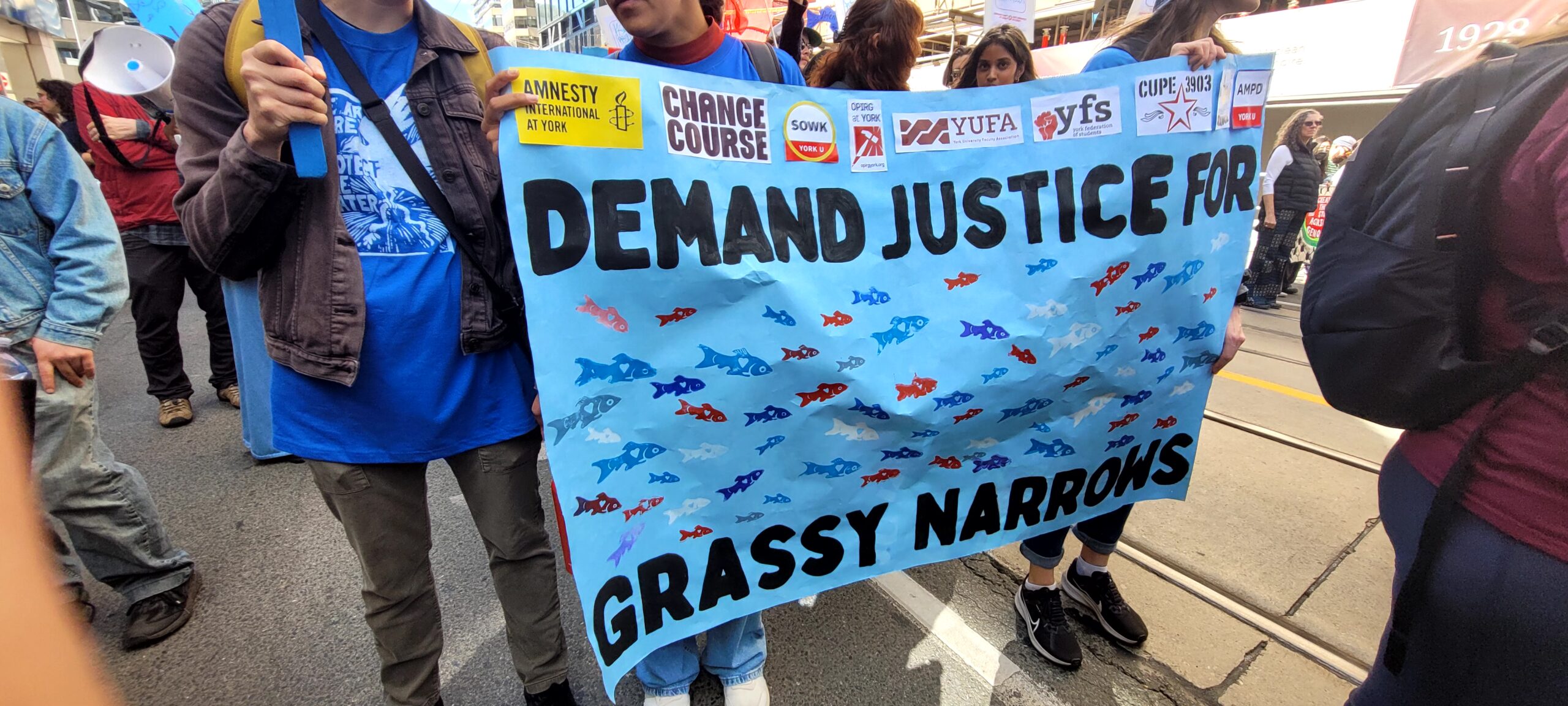
At noon on Sept. 23, thousands of people gathered in downtown Toronto for the Grassy Narrows River Run Rally, demanding justice for the ongoing mercury poisoning epidemic affecting the population of Grassy Narrows First Nation. The community, also known as Asubpeeschoseewagong Netum Anishinabek, has a population of under 1,000 people who reside about 150 kilometres from Dryden, Ontario.
The protest saw a sizable turnout, including York University students such as Anusha Bhadra. A mature undergraduate student in political science and organizer of York’s contingent, Bhadra notes that there were “approximately 50 to 60 people, primarily students” who were a part of her group, alongside nine other organizers. Bhadra describes the march as pleasant and energetic, with a less prominent response from local law enforcement.
Grassy Narrows has struggled with mercury poisoning for decades, dating back to the 1960s and 70s after the Dryden Paper Mill dumped an estimated nine tonnes of mercury into northwestern Ontario’s English-Wabigoon River System. Ongoing pollution levels remain, and a 2024 study found the mill’s active production is still discharging wastewater, which has combined with previous mercury deposits to form a more hazardous compound. The mill was acquired by Dryden Fibre Canada from the company Domtar in August 2023.
The issue has been continuously pressed by residents and non-residents alike, many of whom are saying the Ford government has yet to act on the crisis. The lack of substantial response is something that YFS VP Campaigns and Advocacy Farida Fouad calls “abhorrent,” and she highlights “a level of urgency and accountability that has been profoundly absent.” Fouad adds that instead of the Ontario government acting regarding Grassy Narrows, it has decided against any measures. To Fouad, “Ontario’s own historical record makes this especially infuriating,” as scientific advice supported active cleanup decades ago.
Fouad points to a deeper colonial history that she believes contributes to the government’s lack of action. “A settler-colonial system benefits when Indigenous peoples’ ability to remain on, sustain themselves from, and exercise authority over their lands is undermined,” she says. When communities suffer and bear the consequences of industrial contamination, dispossession deepens for said communities. As Fouad puts it, those that “seek access to Indigenous for development and resource extraction” are served instead.
While Bill C-61 died following the prorogation of Parliament in 2025, the federal government introduced Bill C-37 in June 2026, a similar proposed legislation addressing clean drinking water, wastewater, and source-water protection on First Nation lands. The bill does not specifically address the mercury contamination in Grassy Narrows, leaving calls for a cleanup unresolved.
