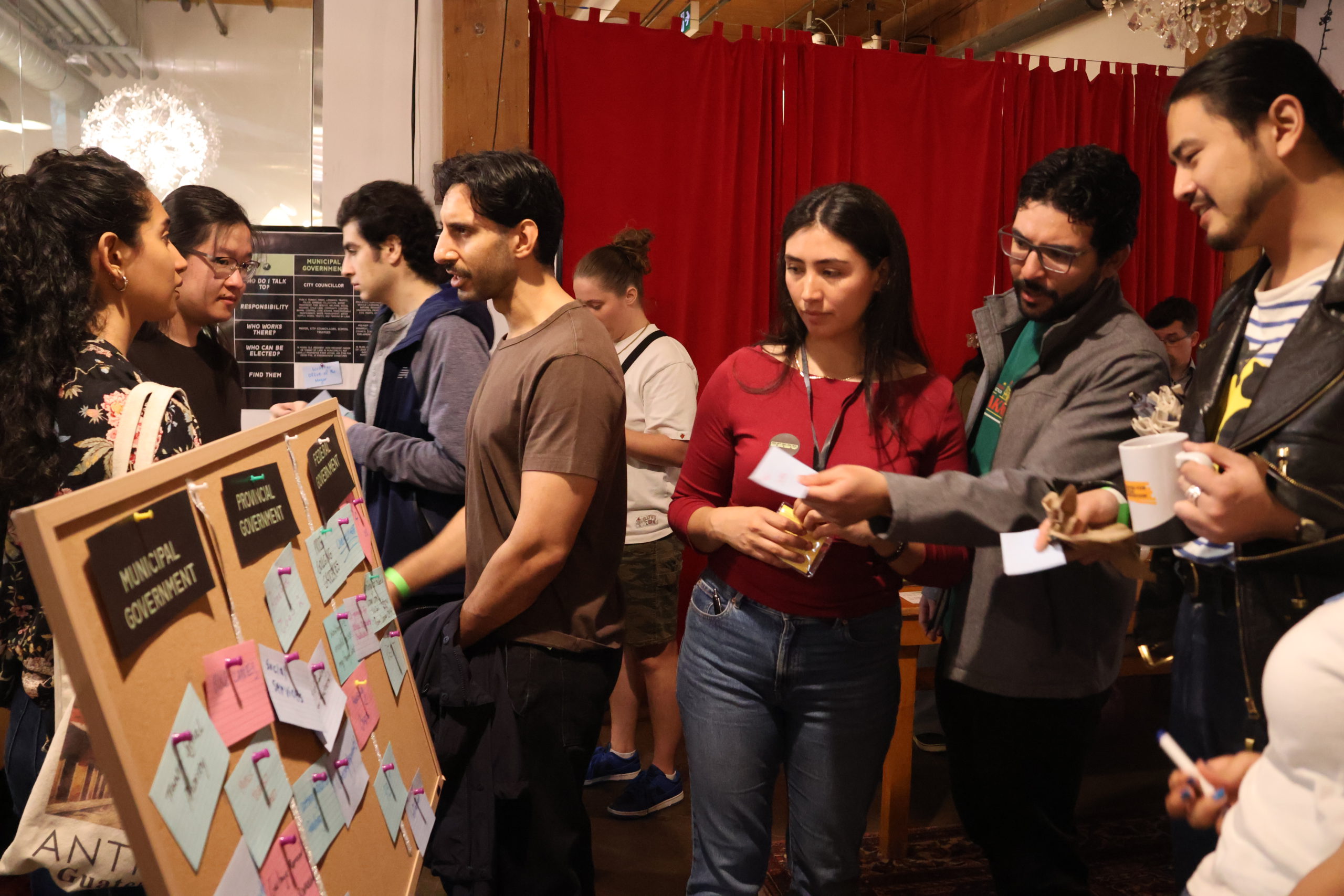
During the afternoon of April 18, Toronto youth mingled, snacked, and learned ways to engage with democratic processes at SpeakEasy, a free educational coffee party organized by RISE Toronto. Attendees circulated between stations of gamified activities on topics like Canadian voting requirements, detecting misinformation in news headlines, and how to contact different levels of government representatives. Held in the Centre for Social Innovation, the room was thrumming with a warm energy fostered by the backing tracks of DJ Tangerine and an ample supply of baked goods and drinks.
Excalibur spoke with RISE Toronto ambassadors Jordan Maragh-Cowlard, Lily Shulman, and Jonathan Dong, who all agreed that the event was a definite success. The coordinating team for SpeakEasy consisted of 11 youth ambassadors who comprise the Toronto branch of RISE’s fifteenth cohort. Created by the non-profit organization Apathy is Boring, and funded in part by the Canada Service Corps, RISE is an initiative that seeks to engage youth between the ages of 18 and 30 who possess minimal volunteering experience with community-based organizing. Based in eight hub cities across Canada, RISE ambassadors are provided with mentorship, training, and $4000 to develop a community project over the course of 15 weeks.
In the case of SpeakEasy, this development began with canvassing over 100 Toronto youth to determine the barriers preventing them from engaging in Canada’s democratic processes. Shulman explained that “it was important that our event…catered to youth in Toronto that aren’t as civically engaged as others,” as well as “people of all levels of education.” Based on their findings, additional research and ideation took place to narrow down the cohort’s specific organizing goals, and tasks were divided among smaller teams to manage the project’s execution. Dong described the process as “collaborative and consultative at every step.”

According to Maragh-Cowlard, this consultation and collaboration paid off. “Many event attendees not only completed the activities but actively engaged with them,” she remarked. “I think more people are interested in learning about our democracy than we give them credit for.” Maragh-Cowlard and Dong attributed the event’s success to the game-like presentation of activities, which offered a refreshing deviation from more academic educational methods. Shulman agreed that the low-pressure environment allowed people to “show up and just be curious,” which they felt was “heartwarming to see.”
While SpeakEasy was a one-off project, all three ambassadors agreed that there is no drought of local youth-organized community events. “Youth organizing in Toronto is very prominent. You just need to know where to look,” Shulman remarked. However, each of the ambassadors also acknowledged that there are obstacles preventing accessible community organizing. “These days youth have less time, energy, and resources to allocate to organizing,” mentioned Maragh-Cowlard. “Economic stressors paired with the lack of sense of community can make organizing seem like a daunting task.” Dong echoed these sentiments, and further commented that “organizing remains personality- and bubble-centric.” Shulman observed that “most third spaces and events require money, which automatically excludes such a large population.”
Despite these issues, they each held a positive outlook on the future state of affairs. “More and more youth are realizing how much impact their voices can have,” Dong proclaimed. “I think we are moving towards ideas that motivate people to do more for themselves and their communities.”
To these ambassadors, the RISE program was a foundational part of their involvement with community organizing. “I moved to Toronto around three years ago,” Maragh-Cowlard explained, “and between working full-time and studying part-time, I found it difficult to find the time and energy to get involved in my community.” Upon seeing an Instagram post advertising the program, Maragh-Cowlard thought it “seemed like the perfect opportunity to meet other youth who are passionate about making a positive change in their community, as well as [to build up her] community organizing skills.”
Similarly, having recently graduated from Humber Polytechnic and registered with the Ontario College of Social Workers and Social Service Workers, Shulman “was looking to expand [their] network,” and was referred to RISE by a past professor. “The program and the people I met have inspired me to continue in this field of work and connect with my community,” Shulman happily reflected.
Dong also joined RISE in the hopes of gaining guidance on his career, starting the program in his final semester of university. The decision came to him “after thinking for a bit about what comes next, being frustrated with youth disengagement, and looking for ways to make a real difference in [his] community.” Dong found the experience of organizing SpeakEasy to be extremely rewarding. “I wish I could turn back the clock and do it all over again,” he reminisced. “Now, at the end, I look forward to the next opportunity.”

Apathy is Boring is currently seeking youth interested in becoming a part of their next cohort of RISE ambassadors. Applications are open until May 24. For those interested in applying or generally becoming more involved in community organizing, each of the ambassadors had some words of advice. To Maragh-Cowlard, the most important thing is to “just act on what you care about.” She reflected, “I spent so much time thinking about how I could get involved, and I wish I had put myself out there earlier!” Dong also encouraged taking a leap of faith, stating that “too often, we fall into a trap of waiting to see if someone we know is going to do something with us, or we put it off.” As he explained, “one of the inherent advantages of our age group is that the struggle is real and affects all of us. If you are having a tough time finding a job or making friends outside of your existing ones, chances are there will be people wherever you go who have the same issues.” Leaving your comfort zone in order to build new relationships was key to Shulman as well. “Make time to connect with others, send those applications, and message that person you met,” they recommended. “You won’t know if you don’t try!”