

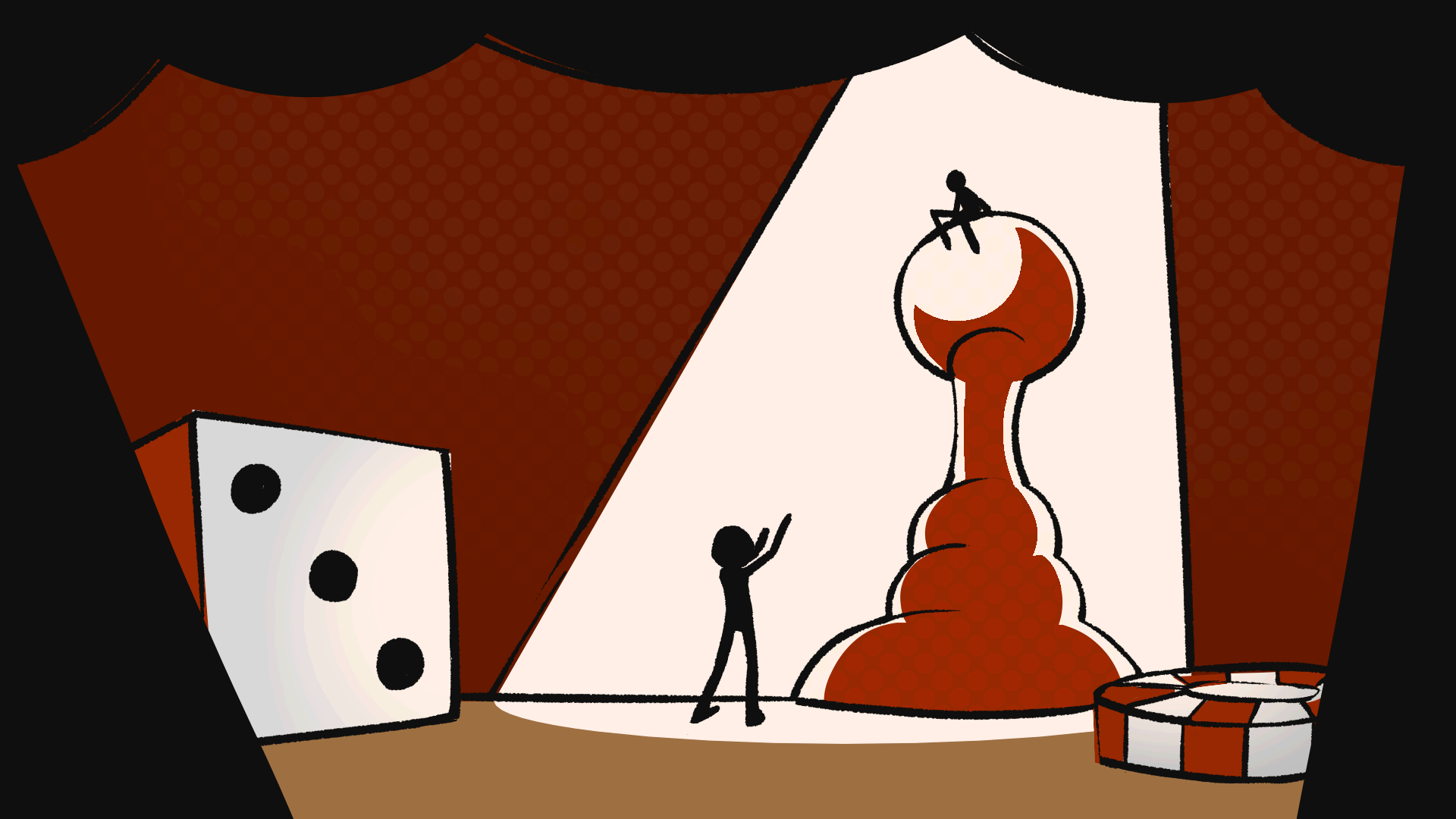
Did you ever expect to go to a show where you control the actor as if he were a video game character? What about playing a board game that involves creating a utopic society within a theatre performance? This niche of theatre is being studied at York by fourth-year PhD candidate Derek Manderson, who recently shared some of his insights with Excalibur.
Commercially, incorporating participation and gaming elements into theatre offers significant financial gain for the industry. Manderson suggested that “as theatre continues to find its place and is struggling financially, an important thing to think about is: how do we appeal to the people that play games?”
As an example of success, Manderson cited asses.masses, a Canadian performance that has toured South America, Europe, and Asia. Dramaturged by fellow York PhD student Laurel Green, Manderson described asses.masses as “an eight-hour performance where audiences play a video game.” Beyond the impressive audience retention, Manderson finds the performance notable because “Canada doesn’t output a lot of theatre internationally.” To him, this global impact highlights the potential of game-based performance to engage new demographics.
Game-based theatre approaches offer unique opportunities for audiences to experiment within the performance. New Societies by the Vancouver/Toronto-based theatre company, Re:Current Theatre, is one such case. Manderson explained that New Societies “invites audience members to be put onto eight different teams that are building their own little societies using this board game that has them harvesting different squares, investing in advancements and making different moral decisions.” The performance fits into a subgenre of strategy games called “4X,” where the principle actions of gameplay are: explore, expand, exploit, and exterminate. In New Societies, these decisions impact other groups and build the theatrical narrative.
“The fact that the performance is using a colonial framework impacts the kind of societies that can be made in this game,” Manderson added. “The performance ends in disaster and I think it’s trying to expose that the frameworks we use in capitalism are not conducive to a utopian society.” When asked if the game was rigged to always conclude poorly, Manderson admitted that he didn’t have the complete answer, due to Re:Current Theatre not wanting to be too transparent about their design system. The company did confirm it was mathematically focused, so in theory the game could end without a disaster, though Manderson feels that this is unlikely. “The big thing is that teams can choose if they want to overharvest and try to push for a few extra resources. As far as I understand it, the math of the game works out such that if there is any amount of overharvesting, the resources will run out in the world and things will blow up. And because you’re getting eight teams of players, there’s a virtual guarantee that at least one of the teams is going to overharvest a little bit just out of greed.” Manderson summed up New Societies as a “provocation” that encourages audience members to consider how they can meaningfully change preexisting social frameworks.
In a similar vein, another purpose that this kind of participatory theatre serves is to facilitate the exploration of unfamiliar experiences by varied audiences. An example Manderson gave was No Save Points, a one-man show by Sébastien Heins that centres around a character with Huntington’s disease. Audience members play on a Game Boy that is hooked up to haptic pads on Heins, so that when they press left or right he gets a buzz on the muscles of the respective side and moves accordingly. Manderson described No Save Points as “exploring what it means for someone who doesn’t have full control over their body to perform alongside that force. The audience members are giving him inputs to tell him how to move and he’s moving, but he’s doing it in his own way.” To Manderson, the performance showcases “how two forces can collaborate in one body. It’s an exploration of collaborating with Huntington’s just like Heins collaborates with the audience, and what it means to move in the world with Huntington’s is something we can explore in the game.”
Overall, Manderson remarked that “part of the pleasure of [participating in theatre] is because suddenly the performance in a way becomes a bit about me. I, as an audience player, get to impact the performance. I get to decide where I go.” As for where he and the growing corpus of game-based theatre are going post-graduation, all Manderson knows is that “something that’s got a little bit of theater, a little bit of games, and teaching and learning — that’s the dream for me.”
