

“I was born on stolen land and I live on stolen land.”
On Nov. 13, 2025 I watched Letter to My Tribe at the Nat Taylor Cinema, a video essay by b.h. Yael featured at the Toronto Palestinian Film Festival that explores the question: “Why don’t more Jews and Israelis speak out about Palestine?” The event was followed by a live Q & A with Yael, an artist, filmmaker, and OCAD University professor.
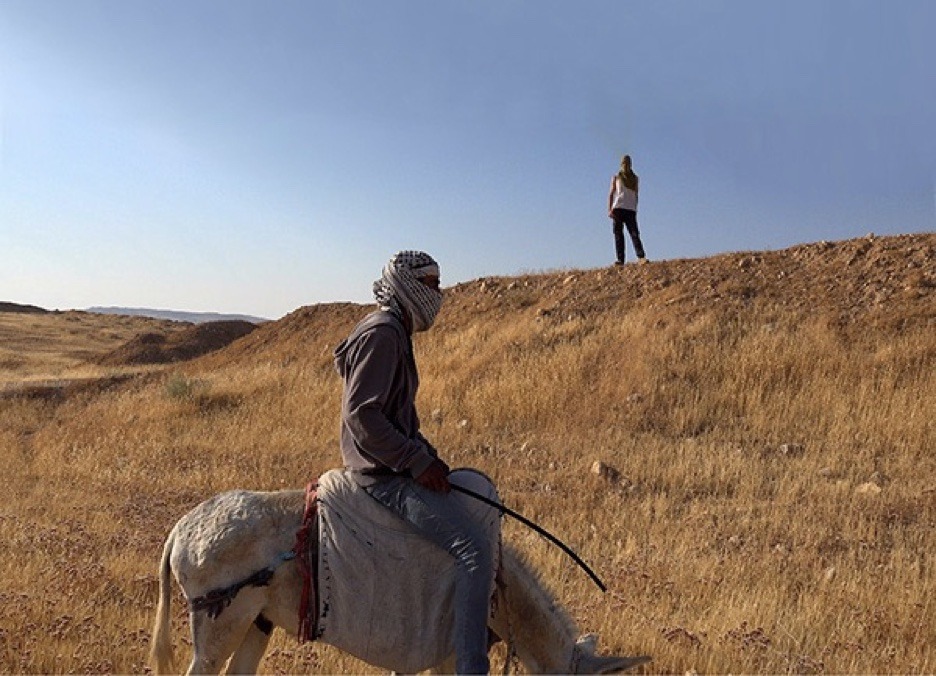
I was apprehensive when I entered the room, afraid of seeing images of violence and terror, of becoming slowly desensitized to horror and human pain. But instead, Yael’s film centered on conversations with her mother, a Jewish woman born in Iraq who moved to Israel before emigrating to Canada. The film depicts Yael’s trips to Iraq, Israel, and Palestine and the conversations she has with Jewish and Israeli people—lawyers, rabbis, and authors. Many of the people featured in the film reflect Yael’s viewpoint, which acknowledges the political motivation behind Israel’s genocide of Palestinian people and condemns the harm Israel has done to Palestinians. The film contrasts these conversations with the ones Yael has had with her mother, which depicts anger and frustration from both mother and daughter due to their varying viewpoints.
“What you saw in the video was mild compared to what at least sometimes happens,” Yael told me during our conversation. “We’ve said we can’t talk about this, we won’t talk about it, but inevitably it comes up because it’s part of our lives. And I have at times just felt very alienated from her…How can you not see what’s going on and not be completely devastated and angered by what Israel’s doing?” Yael continued that at some point she realized the media her mother was consuming was telling her a very different narrative of strong anti-Semitic and anti-Jewish racism in Canada. “I think [these] misdirected, erroneous, and exaggerated accusations of the rise of antisemitism feed into very basic fears that Jews have and…amplifies them,” Yael contended.
As I watched, I couldn’t help but notice the similarities between what Yael reveals about her relationship with her mother and my own tenuous relationship with my mother, who is Muslim and immigrated from Pakistan in her late twenties. We have argued about politics and Palestine, but also religion, cultural norms, morals, feminism—nearly everything that composes the basis of who we are and how we live. As a pro-Palestinian, her opinions tend to be the opposite of Yael’s mother’s — as in hostile towards Jewish and Israeli people. I remember when I once had to go to my optometrist who is a sweet old Jewish man, and my mother refused to take me in the wake of Oct. 7, 2023. She went to the extreme of trying to switch our family optometrist despite the fact that we’d been going to him for my entire childhood. I attempted to persuade her that Judaism and Zionism were not codependent, but the media that she consumed and her interpretation of her religion told her the opposite, and so the switch was made.
Yael notes that her mother often contradicted herself from one sentence to another. As a Jewish woman of Arab descent who grew up in a Muslim majority country, she exists in this liminal space that is confusing and conflicting. “She says, ‘I don’t agree with what Israel’s doing,’ but in the next conversation she’ll be defensive of Israel,” Yael said. This back and forth, I told Yael, is very common with my mother, too. “[She’s] struggling to cope with having her own ideas while also being religious in the way that [she] thinks [she] needs to be religious, which for [her] is that [she] needs to believe every single word that’s in the Quran,” I told Yael. “But if some of it doesn’t align with [her] own beliefs or [her] own experience…then there’s a bit of conflict.”
My mother tends to say hateful things aimed at Jewish and Israeli people, in a much more direct and harmful way than Yael’s mother did in the film. Unlike Yael, I swallow my tongue around her and try not to get into arguments because our mindsets seem diametrically opposed to the point of futility.
Yael and I also spoke about the contradictions underlying our personal identities: how we are both coping with the idea of existing on stolen land that has benefitted us in so many ways at the expense of the rightful owners of the land. As someone born in Canada who has been ostracized for being a second-generation immigrant and a culturally-Muslim person—or someone who was brought up Muslim and is still shaped by Islamic culture—I understood Yael’s struggle to make sense of an intersectional identity that is rooted in colonialism, gentrification, and genocide. As a child, Yael struggled to understand her multiple converging identities as an Israeli-born, Jewish Canadian, which was only solidified when she examined her ancestral history. This gave Yael a more political and “critical” understanding of her Jewish identity, allowing her to “counter and challenge what Israel has been doing in terms of mobilizing a very narrow Jewish identity…in their ethno-nationalist purposes, and in their historic and ongoing dispossession of Palestinians of their land, as well as the kind of violence that Israel has been part of right from their inception.”
I admire Yael and her mother because no matter how hard the conversations became in the film, at least they continued to have them. Yael’s mother never shut down the issues her daughter raised, and always did her best to justify her viewpoint in a way her daughter might understand. When considering the nature of these conflicts, I find myself coming back to a line written by the poet Rumi, who describes a space “beyond right and wrong.” Underneath political, religious, or cultural clashes, as daughters, our relationships with our mothers continue to feed off of a love that seems to exist outside of all material things. All dichotomies, differences, and divergences aside, my mother is still my mother, no matter how much her opinions infuriate me.
Letter to my Tribe is an important moment in history which shines light on the issues that many people of Jewish diaspora presently face as they navigate the world’s political climate. Yael’s film and discussions with her mother operate as a microcosm of the world at large: the conversations we are having with each other, and the religious, political, and cultural barriers we are breaking down. Talking to Yael as a culturally-Muslim person I realized our conversation was also a microcosm of that space that Yael wants to create—a safe space of solidarity and understanding despite differences of any sort.
Politics exist in many spaces: Yael’s Jewishness is political, her mother’s Jewishness is political too (although she denies this), my agnosticism is political, my mother’s Muslim identity is political; all in varying ways. Just by identifying in a certain way and holding a political opinion it is possible to offend someone, but despite all these differences in our arguments with our mothers, there is always love underneath.
Learn more about b.h Yael here.
