
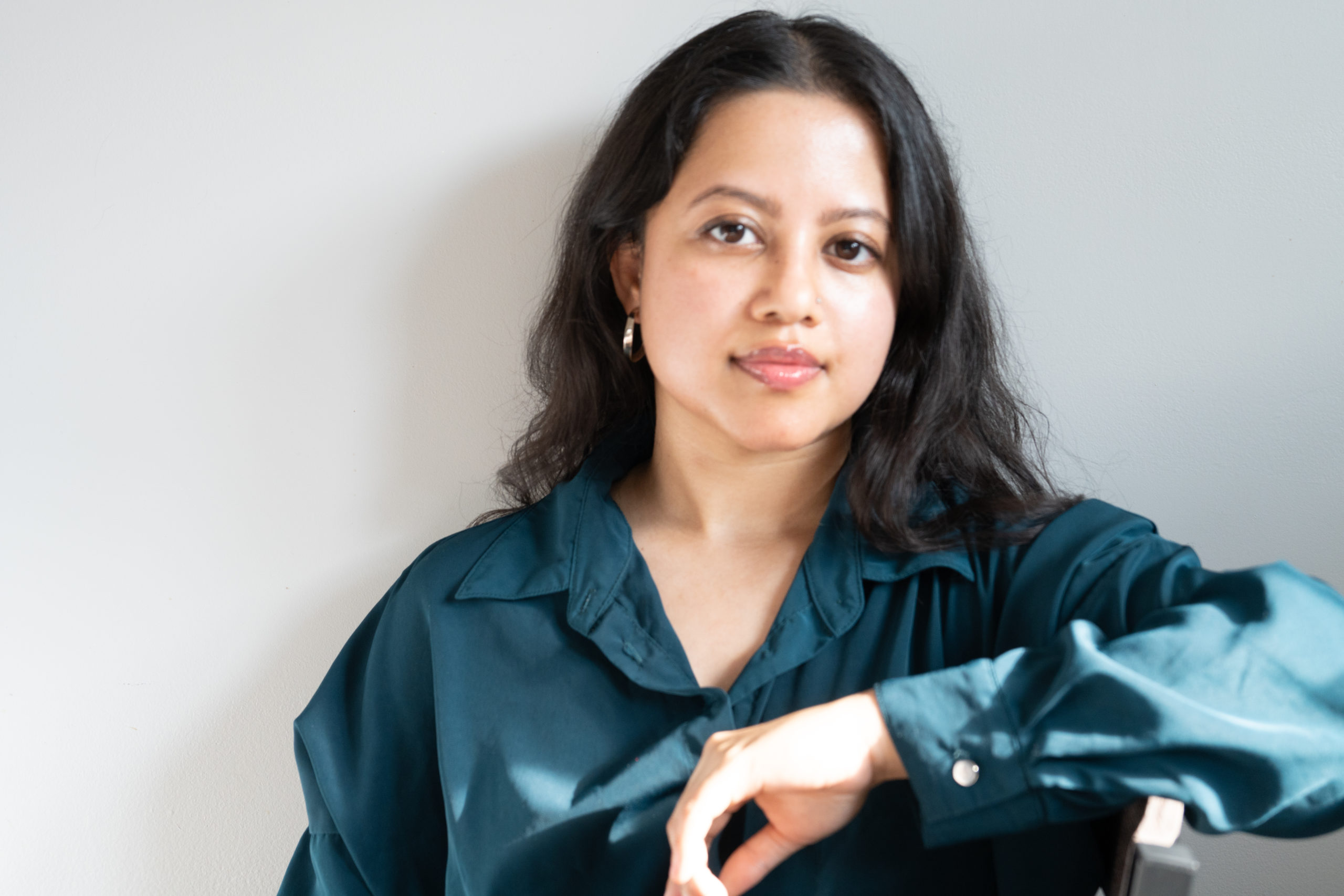
Shammah Salwa, an emerging Toronto-based multidisciplinary visual artist, sits in a liminal space between the West and the East, the corporate and the creative, the political and the personal. Her visual pieces incorporate her educational background in environmental studies with her cultural background in Bangladesh, allowing her to process climate grief while amplifying her voice and bringing her stories to the world.
With a degree in Environmental Studies from University of Toronto, Salwa’s photography, painting, and sculpture skills are mostly self-taught with the exception of a community-based photography course she took with Next Generation Arts, a non-profit arts organization in Scarborough. Her art was showcased at a group exhibition with Gallery 44 Centre for Contemporary Photography and JAYU in 2023, and this experience, she said, was the pivotal moment in her career when she decided that she wanted to create art on environmental justice for a living.

Salwa’s work started in documentary photography and transitioned to experimenting with painting, drawing, and assemblage. She is especially interested in using found materials for her work, as inspired by American multidisciplinary artist Jack Whitten, whose work radically reinvents the artistic process and pushes the boundaries of abstraction and materials that can be used for art. Salwa is re-using plastic material from her own home for a project that she hopes will bring awareness to the impacts of plastic pollution on rural landscapes and communities that she noticed during her recent trip to Bangladesh.
“I guess I had this ideal vision in my head where the rural areas of the country would be untouched by all this plastic pollution, but also air pollution and all of that. And then I went there and it completely shattered my preconceived ideas of what I thought the place would be like.” This, she says, upset her because of the responsibility she feels as a person from the Western world. “I would see a lot of plastic accumulation, and I’m thinking…I know where this plastic is coming from. It’s coming from the West…and somehow it would go from the cities, the urban environments, and then it would travel with human beings, and then it would end up at these villages.”
After this experience, she asked her uncle why there is so little awareness around pollution and so few discussions about waste-reduction in the village. He responded, she recounts, that “people are just trying to survive day-to-day,” and that without the local government taking the initiative to make a difference, nothing will change.
Coming back to Toronto, Salwa recounts the feeling that she was complicit in the pollution in Bangladesh, and she began reflecting on and processing her emotions through a series of art pieces that incorporate household items in new and innovative ways.

Salwa works a remote full-time job and spends her evenings working on her art — and she shares some of her grievances about this. “We’re living in a capitalist system where you have to work a day job that you are not inspired by…and that leaves no time to really reflect on the world that is suffering. There’s so much suffering in the world — when do you get time to really reflect on it?”
Her art, she says, is her method of grieving. Even as she does this, her full-time job, which she describes as being on-call, requires her to never fully unplug. “I feel like a lot of people need to be more in touch with their creative expression. We’re just finding some sort of creative outlet, because people are getting more and more isolated. They’re individualistic.” Apart from creative work, Salwa also encourages finding community in political organizing or social or cultural activities to combat the sense of isolation and grief she observes.
Salwa’s advice for young and emerging artists is to find a balance between daily responsibilities and art. Starting, she says, is more important than completing a project. She also advises emerging artists not to worry about the final product. What matters, she explains, is “just having fun with it as you go and experimenting as much as possible.”
Learn more about Shammah Salwa’s work on her Instagram: @s.sqlwa.
